
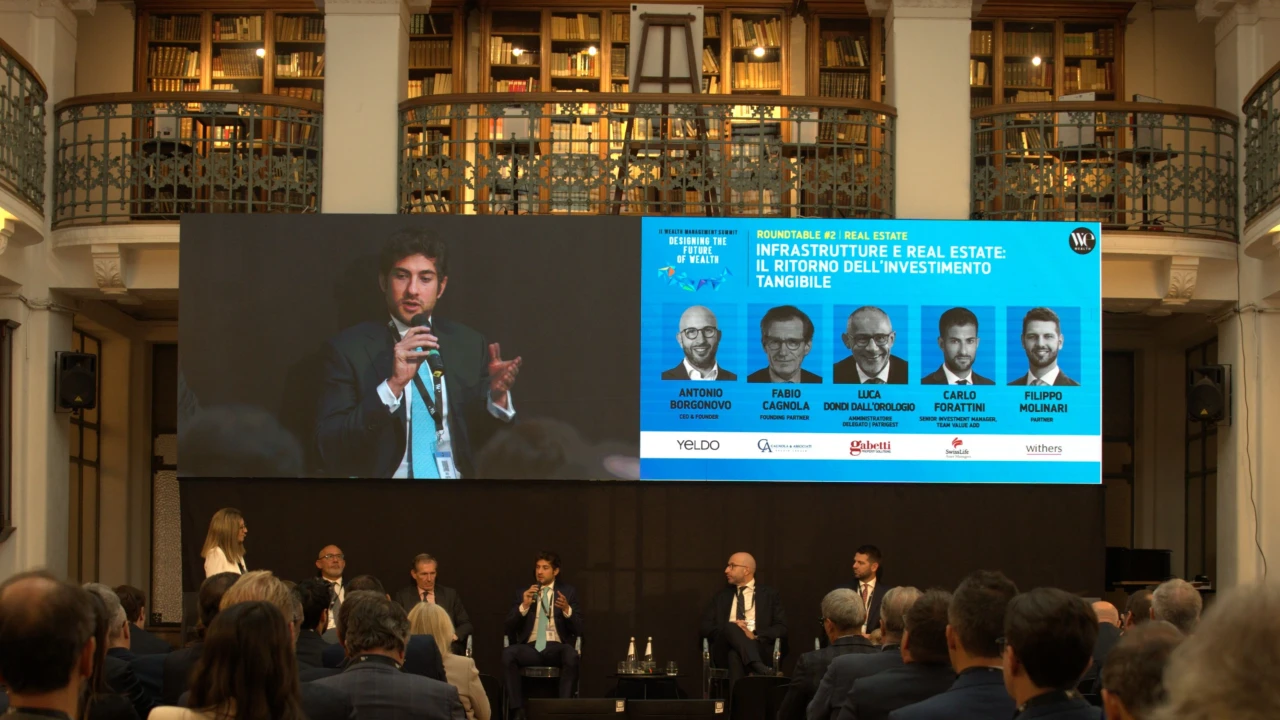
Real estate and infrastructure investments: why “tangible” assets are making a comeback
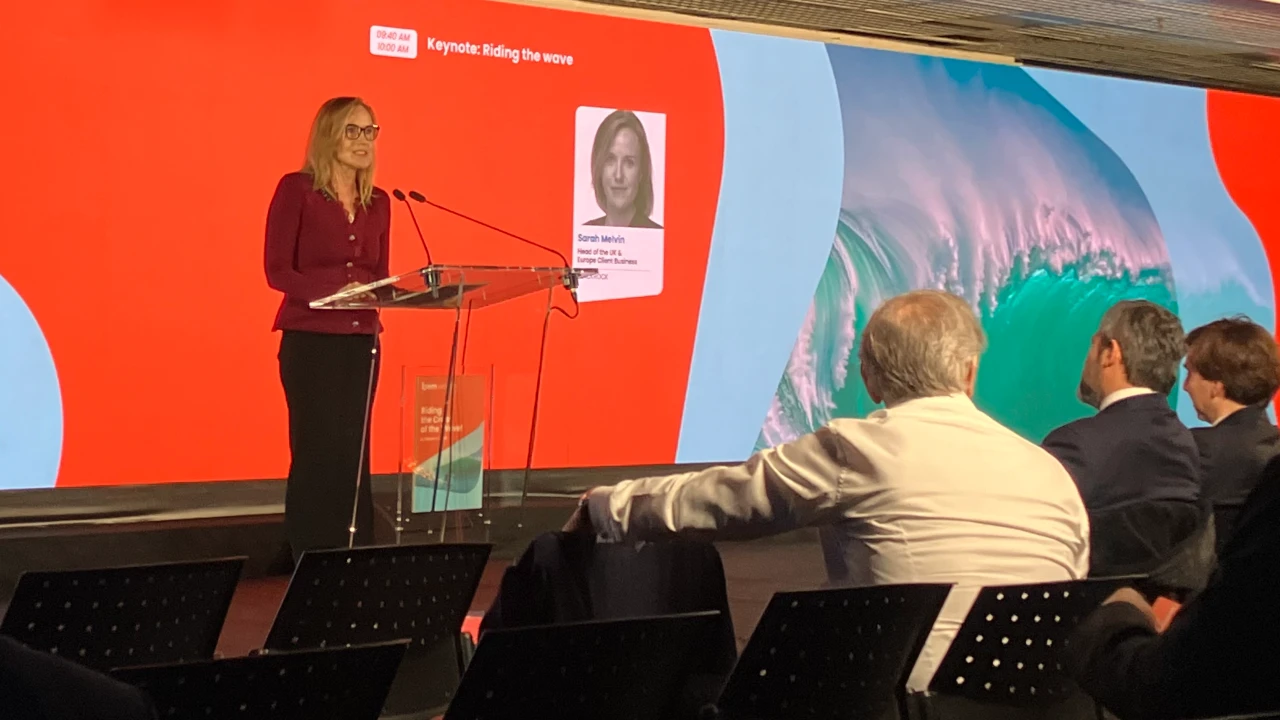
In a rapidly changing market, bricks and mortar—whether physical or infrastructural—are once again attracting private investors, family offices, and institutional players. Real estate and infrastructure are emerging as instruments of stability and protection. This was confirmed at the panel discussion “Infrastructure and real estate: the return of tangible investments” at the We Wealth 2025 Wealth Management Summit.
Dondi (Patrigest – Gabetti Group): housing, market liquidity, and new asset classes
Housing remains a pillar, but watch out for “inflated” values
“Real estate is a constant factor in household wealth,” explains Luca Dondi dall’Orologio (Patrigest – Gabetti Group), referring to the cultural roots of the home, which is considered a safe haven. But he warns: “Real estate often tends to be given a perceived value rather than a real one,” an attitude that fuels the search for security in an uncertain environment. And demand remains strong: “One million households are constantly looking to improve their housing situation through property ownership, even if it means increasing their debt.”
But not all of the market is moving in the same way. “The market is not liquid everywhere,” warns Dondi. “The possibility of exiting the investment varies greatly from one area to another, as does the accuracy of valuations. In less liquid areas, a more careful selection of assets is needed.”
Real estate: new asset classes and diversification opportunities
On the corporate real estate front, however, the picture is more dynamic. “In 2024, we will have invested over €10 billion,” a level that brings Italy closer to European standards while leaving room for growth. Two challenges remain: “There is still an excessive concentration on a few asset classes and too much focus on Rome, Milan, and a few other cities.”
However, there is no shortage of opportunities. “Living in rental accommodation represents an extraordinary opportunity because the demand is enormous,” emphasizes Dondi, who then adds “care facilities, data centers, and even sports and wellness, asset classes that could broaden diversification and the size of the market.”
Cagnola (Cagnola & Associati): Milan, legal risks and urban planning investigation
The urban planning investigation: 120 construction sites and too many conflicting regulations
Fabio Cagnola (Cagnola & Associati) sheds light on the legal risks associated with real estate transactions, drawing attention to the urban planning investigation in Milan. “We are talking about over 120 new building complexes involved, not an illegal attic. The issue here is absolute regulatory uncertainty,” explains the lawyer.
The root of the problem is the overlap between state and regional regulations. “Article 41 of the 1942 law provides for an implementation plan for buildings above a certain size,” he recalls. “But Lombardy Regional Law No. 12 of 2005 derogates from that obligation under certain conditions, an interpretation that was also confirmed by the Municipality of Milan in a circular issued in 2023, which was later suspended.” Hence the conflict: “Is the implementation plan necessary? The Public Prosecutor’s Office says yes; builders and some administrative rulings say no,“ explains the lawyer.
The second issue concerns the building permit. ”When demolishing and renovating, is the SCIA (certified notification of commencement of works) sufficient or is a building permit required?“ asks Cagnola, recalling that ”the SCIA is a certified notification of commencement of works, while the building permit is a more complex administrative act.”
The Via Stresa case and the risk of confiscation even for third parties
The pilot case is that of Via Stresa, in Milan. And the potential consequences are serious:
“In the event of a conviction for building offenses, the confiscation of illegally constructed buildings or illegally subdivided areas is envisaged,” warns Cagnola, “and unfortunately, the confiscation also applies to third-party purchasers, unless they are deemed to be in good faith.” .
The lawyer then calls for regulatory clarification: “Even before going to court, the matter must be resolved in the legislature,” he says, noting that preparatory work is underway in the Senate. “Today, operators are moving on quicksand: clear limits are needed,” concludes Cagnola.
Forattini (Swiss Life Am): private equity and infrastructure, Italy a “reservoir of opportunities”
Infrastructure, the value-add segment is growing: stability and protection from inflation
Alongside traditional real estate, interest is growing in infrastructure capable of offering stable returns and decorrelation. This is emphasized by Carlo Forattini (Swiss Life Asset Managers), who points out that “infrastructure is not a sector, but an asset class, which in turn comprises various sectors” and that “infrastructure has offered cash yields of 6-7%, providing protection against inflation in recent years.”
Within this scenario, the value-add segment is gaining ground, with increasing demand from institutional investors.
Any concrete examples of value-add infrastructure? “We have invested in a platform of diagnostic radiology clinics, a company that rents containers and prefabricated modular buildings, an operator that manages a fleet of helicopters for air rescue, and finally, Planet Farms, which is active in indoor vertical farming,” says Forattini. This range of investments clearly represents the value-add nature of the strategy, on which Swiss Life Am is moving with a target return of 17%. Investor demand is clear: “The same defensive characteristics as traditional infrastructure, but with shorter time horizons (5-10 years) and higher returns.”
Italy as a market of concrete opportunities
As for opportunities, “Italy has been an unexpected reservoir of opportunities,” says Forattini, partly because many competitive processes are “less crowded than in Germany or France.” This is an environment that rewards those who know how to take a constructive approach with entrepreneurs, overcoming the image of “vulture funds” and building long-term partnerships.
Borgonovo (Yeldo): Private debt as a financing lever
Private credit on the rise after the banking squeeze
Antonio Borgonovo (Yeldo) highlights the growing role of private credit in real estate. “In recent years, there has been much talk about the golden era of private credit,” he observes, noting that today “the big private equity asset managers have become predominantly private credit managers.”
The reason is structural: access to bank credit is more complex and demand for alternative capital is growing.
In the case of Yeldo, the focus is on private credit backed by real estate projects, an instrument that combines return and protection. “A fixed-income product that generates a stable, uncorrelated, and diversified return, with the security of real collateral whose value, if the transaction is well structured, exceeds the financial exposure,” explains Borgonovo.
Short durations and strong collateral: the winning formula
For wealth management, the key issue is liquidity. “Investors must avoid overly long exposures. Our model, with investments of less than two and a half years on average, meets this need,” says Borgonovo.
Another lever is compatibility with new evergreen and open-ended funds: “These instruments are suitable for private clients because they combine yield and flexibility,” explains Borgonovo.
This points to a very interesting and underserved market segment: “Real estate transactions between 10 and 50 million: too big for a club deal, but too small for large international funds.” This is where Yeldo comes in: “There is high demand and low supply. This gap allows for low double-digit returns with real collateral guarantees, often twice the financial exposure.”
Molinari (Withers): legal protection, taxation, and trusts, complexity as a value
Regulatory complexity and the inadequacy of LLCs in Italy
The return to the tangible requires a solid legal framework. This is pointed out by Filippo Molinari (Withers), who starts from a key concept: the complexity. “Complexity on three levels: operational, because explaining the dynamics of Italian real estate to foreign investors is not easy; regulatory, such as the verification of reciprocity required by preliminary laws; tax, because the tax factor should not drive a transaction, but must always be carefully studied.”
Added to this are the implications of investments that cross multiple jurisdictions. “With international players, we often find ourselves dealing not only with traditional real estate transactions, but also with passion assets and choices of personal enjoyment,” observes Molinari.
Hence the need to avoid automatisms imported from other legal systems. “An American investor may have to explain that the LLC (Limited Liability Company, ed.), which works very well in the US, is not the right vehicle in Italy.”
The use of a company can create problems. “If the company is foreign,” he continues, “there is a risk of altering tax residence; if it is Italian, the rules on shell companies apply, which are unfavorable.” Not to mention “the taxation of the use of the property as a benefit in kind and the taxation of capital gains.”
For this reason, in many cases, “personal purchase remains the most efficient solution: transfer taxes are calculated on the cadastral value, which is much lower than the market value, and after five years there is no taxation on capital gains.”
The trust as a tool for protection and generational transfer
Finally, Molinari refers to a key tool for international clients: “The trust is well suited to asset protection and wealth planning. Italy is now a trust-friendly jurisdiction. If constructed correctly, the trust protects against possible attacks by creditors and guarantees tax efficiency, which is particularly useful from a generational transfer perspective.“
Conclusions: a word for the future of the tangible
In a word, what is the true value of tangible investment in real estate and infrastructure today?
”Awareness” (Dondi).
“Stability” (Borgonovo)
“Decorrelation” (Forattini)
“Prospective guarantee” (Cagnola)
“Legacy” (Molinari)
Five words that point in the same direction: tangible assets are a tool for value, protection, and planning.
To relive the entire round table discussion, just watch the video below: