

The deep tech market is redefining venture capital investment strategies worldwide, positioning itself asthe high-potential asset class par excellence. Based on scientific discoveries and radical engineering innovations, deep tech startups tackle some of the most complex challenges of our time, from the energy transition to personalized medicine. Unlike traditional tech startups, which often focus on incremental business models or software innovations, deep tech ventures into uncharted territory such as quantum computing, advanced biotechnology, new materials, and cutting-edge artificial intelligence. This entails longer development cycles and greater capital intensity, but also the promise of exponential returns and a transformative impact on society as a whole.
How Europe is moving
The Deep Tech market in Europe has reached a total enterprise value of startups funded by venture capital of $690 billion in 2025, with 60% coming from private markets and recording a 12% growth compared to the previous year. Innovative artificial intelligence accounts for 50% of deep tech funding in Europe, followed by computing (future of compute) and defense.
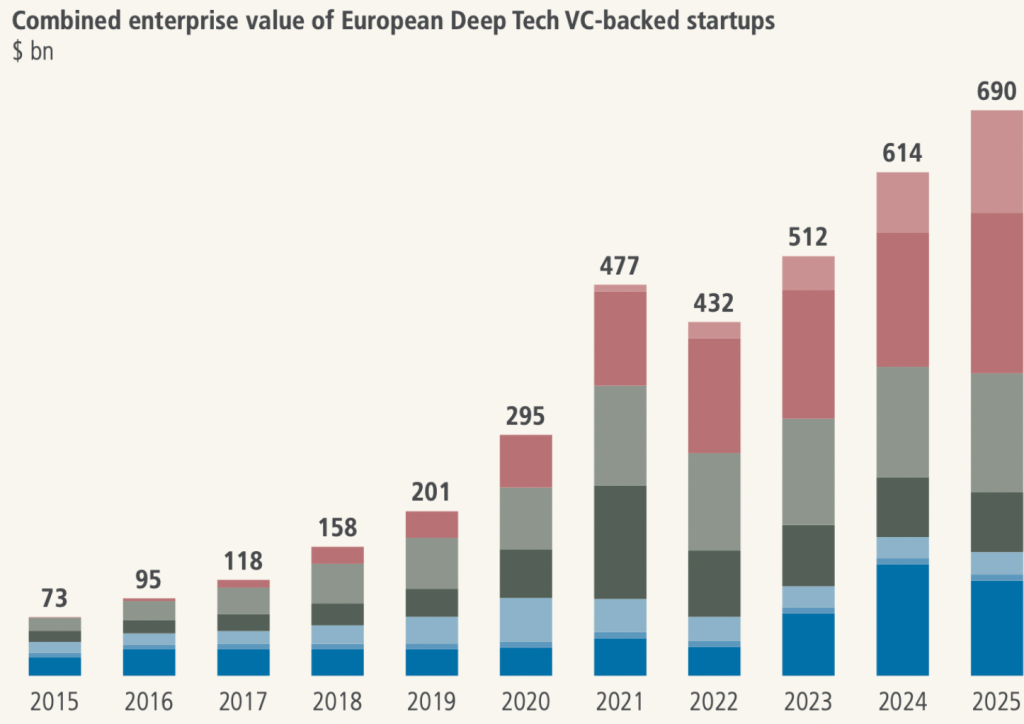
According to Dealroom, the European deep tech market in 2025 has proven to be a strategic pillar, attracting approximately $20.3 billion, accounting for 32% of total VC funding. This is also due to the fact that Europe is home to 30% of the world’s top universities with a focus on deep tech.
This academic leadership positions the United Kingdom as the fundraising leader with $5.2 billion, followed by France ($3.9 billion) and Germany ($3.2 billion) (“The 2026 European Deep Tech Report“, Dealroom, March 2025)
Italy is also showing signs of gradual maturation, with an ecosystem that, although still in the consolidation phase compared to European giants, demonstrates significant potential. In 2025, the deep tech sector was the top sector by investment value in Italy (413 million, 47 rounds), surpassing for the first time the Health & Life Science sector (357 million, 37 rounds) and Software & Digital Services (266 million)(“EY Venture Capital Barometer“, EY, 2026).
Italian Excellence
The Italian deep tech landscape is becoming increasingly dynamic, with numerous startups distinguishing themselves through their capacity for innovation and ability to attract capital. These companies represent the cutting edge of “Made in Italy” technology and span strategic sectors, from the new frontier of energy to advanced robotics.

Newcleo: This startup is at the forefront of the clean energy sector with its ambitious project to develop fourth-generation nuclear reactors. The goal is to provide a safe, sustainable, and environmentally friendly energy source while drastically reducing the production of radioactive waste.
Sinergy Flow: Founded as a spin-off from the Politecnico di Milano, Sinergy Flow is developing an innovative, low-cost, and sustainable flow battery that does not use rare metals. This technology promises to revolutionize large-scale energy storage. In February 2026, the startup closed a €7 million funding round to bring its solution to market
AdapTronics: a spin-off from the University of Bologna that won the Italian Master Startup Award in 2025, specializes in robotic manipulation solutions for industrial and aerospace applications, developing a unique electro-adhesive technology. In November 2025, it closed a €3.15 million funding round led by 360 Capital, with participation from CDP Venture Capital’s Aerospace Technology Transfer Hub.
Magnetic Future: This Bologna-based startup develops high-temperature superconducting switches for advanced magnetic systems, with applications ranging from nuclear fusion to wind energy. Its technology enables entire industrial supply chains and is a key component of the energy transition. The company was one of the winners of Area Science Park’s Deep Tech Revolution call for proposals, securing €200,000 in funding.

Principled Intelligence: Focused on a critically important current issue, this startup develops technologies for the oversight and governance of artificial intelligence. In January 2026, it announced a €1.85 million pre-seed funding round led by CDP Venture Capital’s National Technology Transfer Hub for AI and Cybersecurity.
International startups not to be missed
Globally, the deep tech sector is driven by visionary companies that are pushing the boundaries of technology in fields such as artificial intelligence, quantum computing, and biotechnology.

Anthropic: Founded by former OpenAI researchers, Anthropic is one of the leading companies in the development of advanced and safe artificial intelligence models. The company has raised billions of dollars from investors such as Google and Amazon and is positioning itself as one of OpenAI’s main competitors in the field of generative AI. Its valuation has surpassed $18 billion

PsiQuantum: This startup is working to build the first large-scale commercial quantum computer based on photonics. Unlike other approaches, photonics technology allows the system to operate at room temperature, overcoming one of the field’s major technical hurdles. The company has raised over $650 million in funding and aims to solve problems that are currently intractable for classical supercomputers.

Synthace is a software company based in London, United Kingdom, that develops automation software and enables biologists to monitor and analyze the performance of laboratory equipment.

1X Technologies is a Norwegian-American robotics and artificial intelligence company that develops androids capable of human-like movements and behaviors to meet workplace needs.
DNA Script, a French company pioneering the shift from chemical to enzymatic DNA synthesis (EDS). Drawing inspiration from natural enzymes, their benchtop printer, SYNTAX, enables researchers to create high-quality DNA oligonucleotides on demand in a matter of hours rather than days, accelerating breakthroughs in vaccines, therapies, and data storage.
The Future of Strategic Investments
Investing in deep tech isn’t simply about betting on a new wave of technological innovation; it means actively participating in building the economic and social infrastructure of the future. In fact, companies in this sector do not merely optimize existing processes; they create entirely new industries and markets, tackling systemic challenges ranging from climate change to an aging population. For venture capital investors, this translates into a unique opportunity to generate returns uncorrelated with traditional market cycles, albeit with higher risk and longer time horizons. The very nature of deep tech, based on solid intellectual property and nearly insurmountable barriers to entry, creates a lasting competitive advantage. This potential has not escaped the attention of governments, which view deep tech as a strategic asset for ensuring technological sovereignty and national competitiveness.