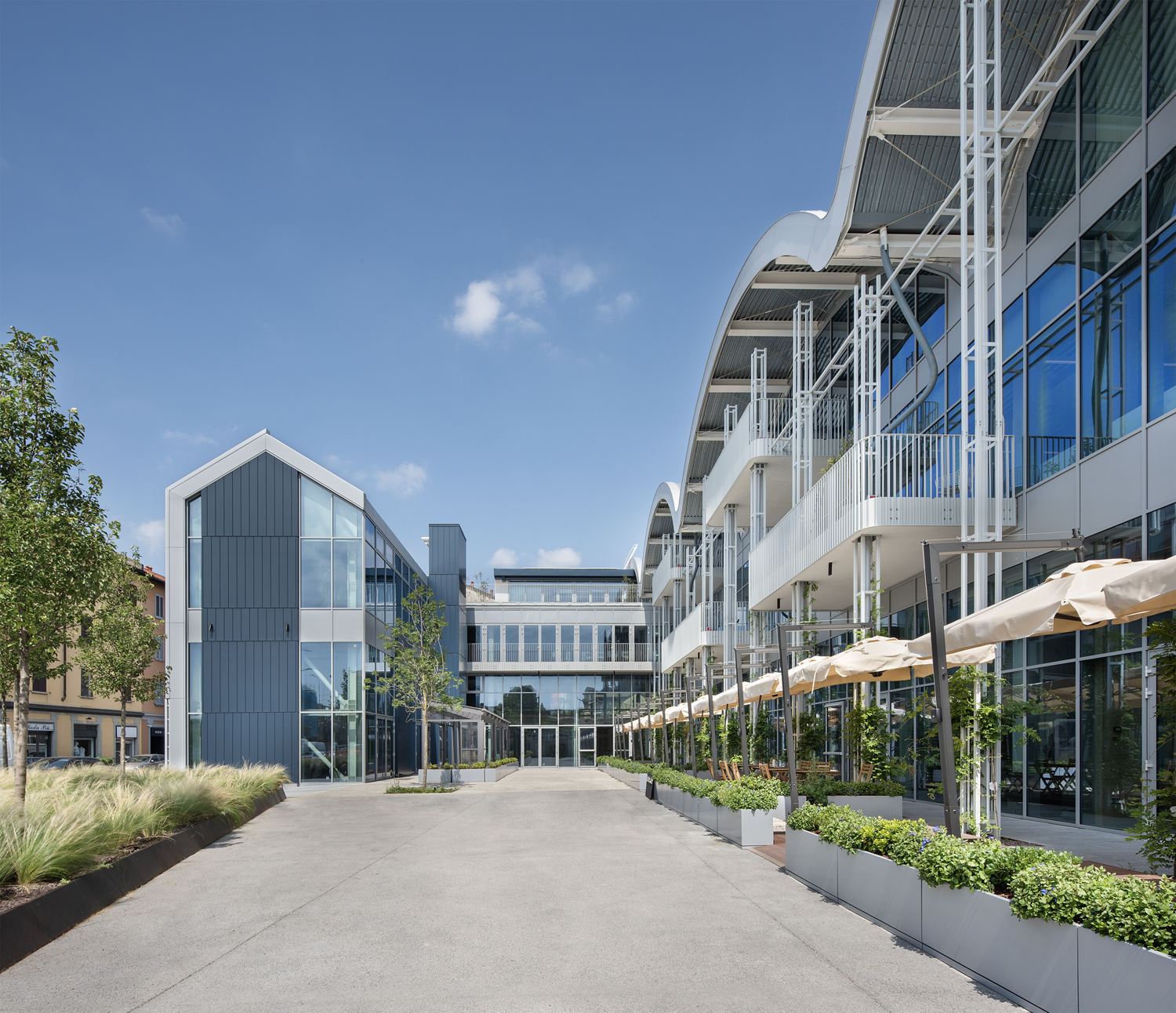
Milan continues to be a pioneering laboratory for urban regeneration, and the Certosa District project, promoted by RealStep SGR, is one of the most emblematic examples. What was once a vast industrial hub in the northwest of the city is being transformed, under the guidance of the Milanese company specializing in the redevelopment of former industrial areas, into a multifunctional district combining offices, culture, green spaces, restaurants, and residential spaces, with an impact that focuses both on quality of life and the creation of economic and social value. “With the Certosa District, we aim to improve the daily lives of the people who live in the neighborhood,” emphasizes Stefano Sirolli, CEO and co-founder of RealStep SGR. “We are giving the city a vibrant area, with a great balance between new construction, greenery and common areas, culture, innovation, and sustainability.”
A model born from the experience of Tortona
The vision guiding the Certosa District is rooted in RealStep’s experience in the Tortona neighborhood, another virtuous example of urban regeneration in Milan. From the area’s former industrial warehouses, now a creative and cultural hub, to the new Certosa project, the common thread is a development that combines historical memory, technological innovation, and social inclusion. RealStep, with over 25 years of experience and more than 400,000 square meters of completed real estate transactions, has made sustainability a strategic cornerstone: low environmental impact, energy efficiency, and attention to the quality of spaces are hallmarks of its projects.
The creation and the beating heart of the district
The cornerstone of the Certosa District is La Forgiatura, a carbon-free corporate campus spanning over 30,000 square meters that has successfully converted a former metallurgical area into an innovation hub. Today, it hosts multinationals such as Medtronic, Zeiss, UCB Pharma, and Sandvik. A place that combines industrial architecture and modernity, with artificial hills, eight buildings integrated into an urban park, and multipurpose spaces.
The €58 million debt refinancing recently completed by RealStep, with the support of BNL BNP Paribas, MPS, BPER, and BCC Milano, consolidates the project’s financial structure and propels it toward new developments. “The trust of credit institutions confirms the solidity of our model and the Certosa District’s ability to attract capital for sustainable urban development,” commented Sirolli.
Finance to support urban transformation
Financial leverage plays a crucial role in the project’s success. RealStep recently signed a financial reorganization agreement for an additional €65 million (€50 million from Unicredit and €15 million from Banca Finint, as part of the Integrated Urban Plans Thematic Fund of the PNRR). This investment model combines private capital and public funds, thanks to the direction of entities such as the European Investment Bank and Sinloc (Sistema Iniziative Locali S.p.A.).
“The Fund’s involvement has contributed to the development of an underutilized industrial area, allowing for the creation of a multifunctional, highly energy-efficient building without further land consumption,” says Mauro Sbroggiò, CEO of Finint Investments and Co-Chief Financial Officer of the Finint Bank Group. “The project aims to transform a disused industrial area into a multifunctional district where, with the involvement of the community, the new office space is combined with the offering of collateral and complementary activities,” explains Antonio Rigon, CEO of Sinloc. Jazz concerts, exhibitions, a food gallery, and a large urban park: these elements make the Certosa District a concrete example of how urban regeneration can go beyond simple building conversion to become a catalyst for social inclusion and economic development.
A model for private investors?
The success of the Certosa District paves the way for a broader reflection: can this type of project become an attractive asset for private markets? The answer seems positive. Projects like RealStep integrate ESG objectives, generate tangible returns in terms of property value, and contribute to the city’s competitiveness. RealStep’s recent transformation into an asset management company (SGR) and the creation of SICAF sub-funds for new investments in Milan and other urban areas confirm how urban regeneration can become a new frontier for institutional investors seeking projects that combine returns and social impact. “The path is clear: Certosa District is destined to become a benchmark for Italian urban development and an opportunity for private capital to participate in building the city of the future,” concludes Sirolli.