
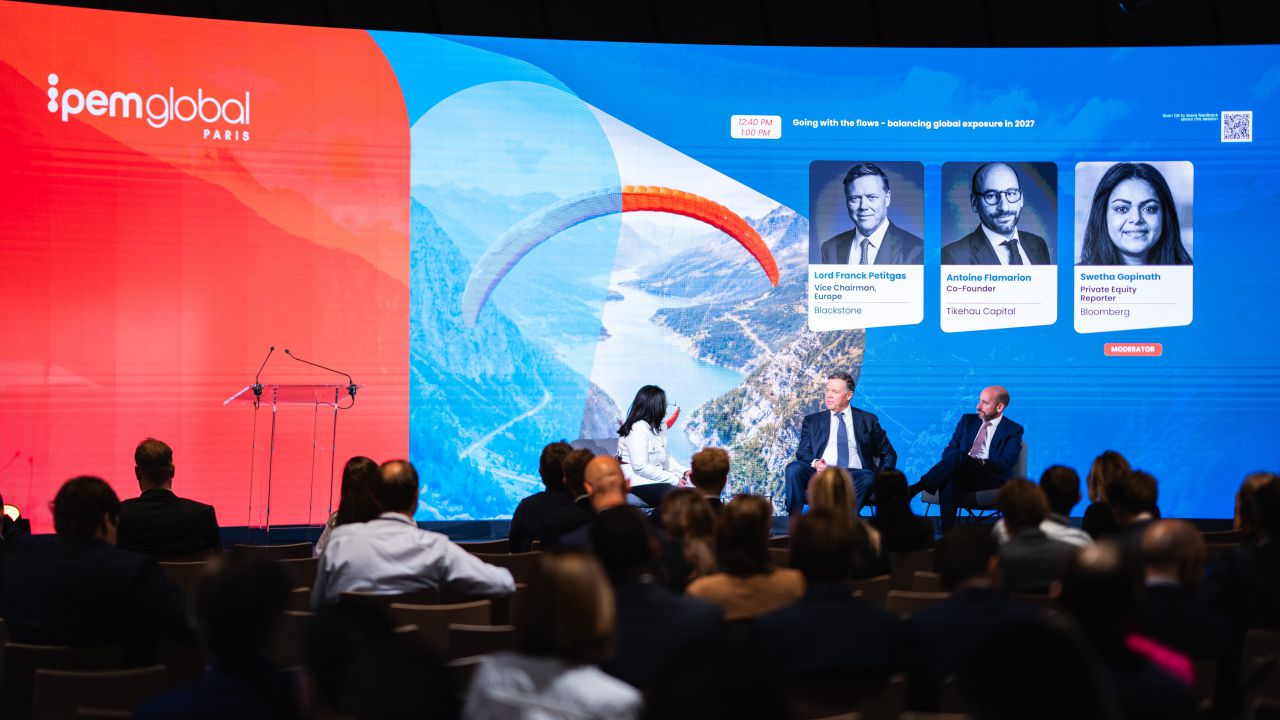
Europe is growing slowly, speaks too many legal and tax languages, and has less liquid markets than the United States. And yet, or perhaps precisely because of this, major private capital players are looking at the continent with renewed interest. The issue was discussed in Paris during IPEM Global 2026, at the plenary panel Going with the Flows: Balancing Global Exposure in 2027, which brought together two complementary perspectives: that of Blackstone, the global alternative investment giant, represented by Lord Franck Petitgas, Vice Chairman for Europe, and that of Tikehau Capital, an asset manager born and raised in Europe, represented by co-founder Antoine Flamarion. The starting question, posed bluntly by moderator Swetha Gopinath of Bloomberg News, was: “Is Europe attracting capital because geopolitics have become more complicated elsewhere, or is there a structural advantage to investing in Europe?”
Three ingredients and a $500 billion plan for investing private capital in Europe
For Petitgas, a former long-time investment banker at Morgan Stanley and later economic adviser at Downing Street, the answer comes down to three ingredients. First is an enormous pool of savings that has so far been only lightly allocated to private markets and remains, to a large extent, “not yet mobilised.” Second is the investment gap: the Draghi report, which the executive calls, without irony, “the bible,” estimates investment needs at around €1 trillion a year. The third ingredient is growth potential. Potential, that is, because growth has so far fallen short of expectations. There are, however, some signs of a revival. According to a Financial Times analysis cited during the panel, between 15% and 30% of the measures recommended by Draghi have already been adopted. And from his brief experience in the British government, Petitgas drew one conviction: supply-side reforms come with a political cost, but require far less in terms of public spending. Hence his explicit warning: “This is not the time to be fashionable pessimists.” Blackstone, for its part, has put forward a $500 billion plan to invest private capital in Europe over the next ten years.
Where there is inefficiency, there is value
If Europe is a macroeconomic bet for the US giant, for Tikehau it is home. And according to Flamarion, the very complexity of the market is what makes it attractive: investing in residential real estate in Portugal has little in common with defence in Germany or decarbonisation. Different jurisdictions, tax systems and cultures require an extensive local presence on the ground. The result is a market that is less liquid and less efficient than North America’s, and therefore richer in opportunities for those who know how to navigate it. On this point, the two speakers agree. Where there is inefficiency, Petitgas observes, there is value. Blackstone operates across the full “colour spectrum” of investment, from credit to real estate and from infrastructure to private equity. But in Europe, the key is not choosing a single country: it is being selective, sector by sector.
“Picks and Shovels” for the great rewiring
For Blackstone, the common thread is what Petitgas calls the rewiring of the economy: energy, infrastructure, digital transformation and artificial intelligence. It is not just about data centres, but about the entire ecosystem around them, from technology applied to healthcare to robotics. Europe is behind when it comes to data centres, he acknowledges, and that is precisely where the opportunity lies. It is not too late, however, to capitalise on the spread of AI into the real economy, in what he describes as the “second phase” of the revolution, where the continent can produce its own champions.
The strategy is the classic “picks and shovels” approach: provide the tools to those doing the digging. With one counterintuitive twist: also look at companies in the physical economy that are less exposed to artificial intelligence. It is no coincidence that, among this year’s investments, Petitgas mentions waste management.
Cycles are getting shorter and opportunities are taking many forms
This is Tikehau’s approach to investing private capital in Europe, as explained by Flamarion: having entered the market twenty years after Blackstone, trying to challenge it on its own turf would have been unrealistic. Better to look for the blind spots.
The group therefore launched direct lending in Europe in 2009, moved into decarbonisation in 2018 and, during the pandemic, began investing in the defence supply chain, made up of companies active in both the civilian and military sectors. Today, it has 35 portfolio companies in the sector. The advantage of a contrarian approach can be measured in multiples: entering at five times EBITDA while investors buying software may pay as much as 25 times. With a dose of luck, Flamarion acknowledges. But cycles are getting shorter, shaped by geopolitics, politics and interest rates, and opportunities are changing form. One of the most recent is private secondary debt: buying discounted positions originated by other large asset managers, including Blackstone and KKR, when fund investors need liquidity.
Investing in European private equity to be an anchor, not a passenger in transit
How can investors generate excess returns in a continent that is growing more slowly than the United States? For Petitgas, there are two main avenues: invest where the need for capital is greatest — namely data centres, energy and infrastructure — and support companies as they grow until they become champions.
Blackstone claims to have built Europe’s leading logistics operator in just a few years. The watchword is long-term capital: to be an anchor for companies, rather than a passenger merely passing through. The issue of scale concerns industry, but also finance. Petitgas, who describes himself as a long-time observer of major corporate transactions, points to Europe’s €33 trillion in savings and the need for capital-markets reforms to put that wealth to work. Tikehau offers its own examples: ChapsVision, a company aspiring to become the European Palantir and of which the group is the largest shareholder, built piece by piece over ten years; and Banijay, listed and now approaching €1 billion in EBITDA. The argument is that it is possible to start with €100 million and reach €1 billion, provided you have the right amount of time, team and sector.
The sleeping nest egg
The biggest issue remains: European savings invested in alternative markets are still limited. Petitgas points out that many companies destined to become champions cannot find the capital they need on public markets, and that this is precisely where private capital can help them grow, enter new markets and adopt AI.
Blackstone, he explains, has launched a joint venture with Anthropic to promote the use of artificial intelligence across its portfolio companies, where adoption has reportedly increased six- or sevenfold in seven months. This is why Petitgas advocates higher allocations from pension funds. At Downing Street, he worked on the Mansion House Compact, which called on large UK pension funds to allocate 5% to alternative investments, a threshold that was subsequently raised. It is a question of returns, but also of broader support: if more people participate in wealth creation, he argues, collective interest in the success of the market economy grows. Tikehau adds the factor of time. Europe is twenty years behind the United States and needs reforms, financial literacy and expertise. But investment needs, from AI to defence, decarbonisation and cybersecurity, are driving a shift away from bank intermediation that is likely to continue. There is one condition: remaining disciplined. Because ultimately, Flamarion reminds us, investing in private markets means “generating performance for your investors.”