
In some cases, the family office is perceived as an alternative or even a replacement for the family business: a structure that is created when the business is sold, listed, or closed. This view, which is still widespread, only captures part of the reality.
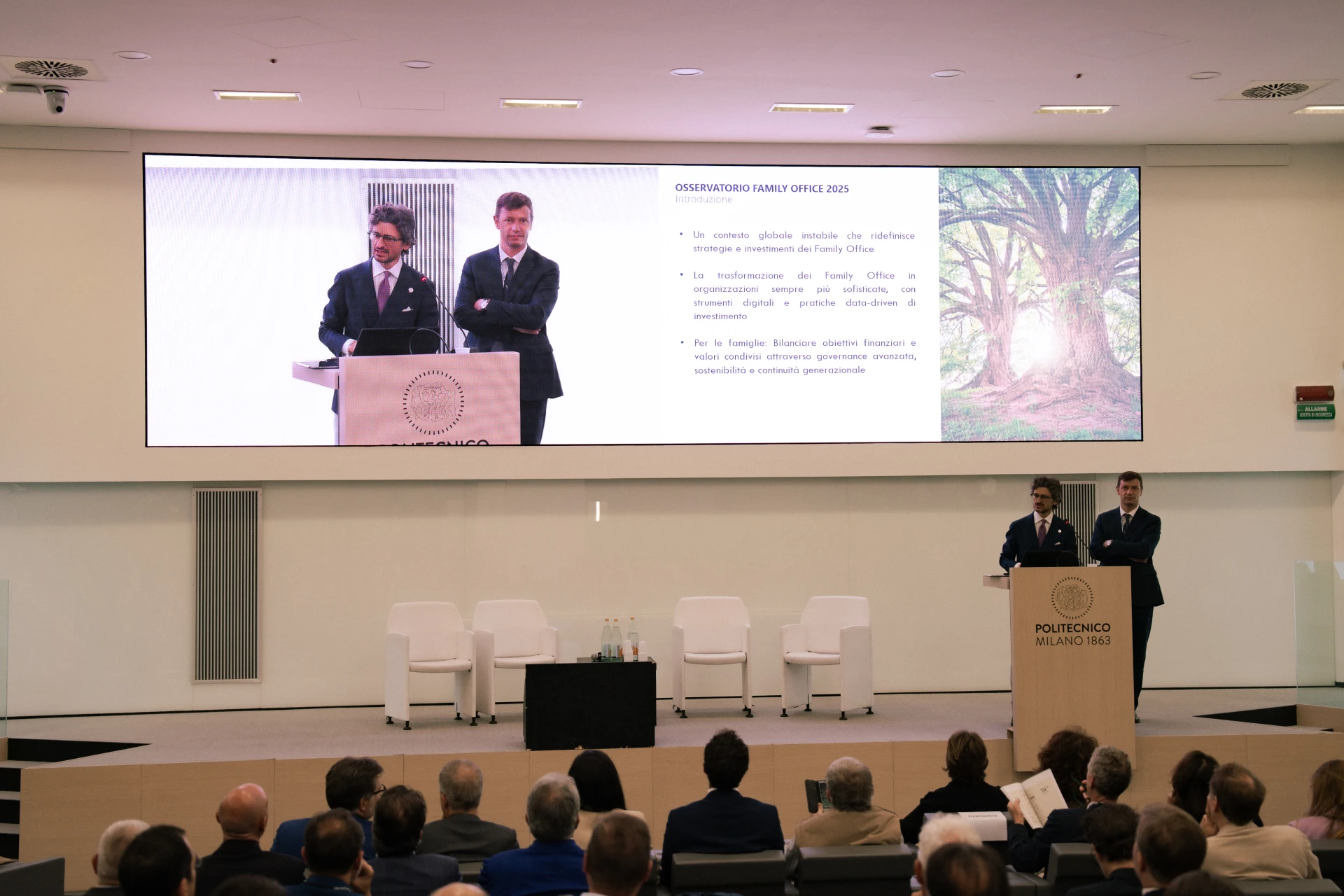
The data and evidence collected by the Osservatorio Family Office 2025 (Family Office Observatory 2025) and in international literature show a very different picture: in most cases, the family office does not replace the family business, but works alongside it, supporting its continuity and strengthening the family’s ability to manage a complex, articulated, and evolving patrimony.
The family office does not replace the family business, it supports it
The growth of family offices in Italy – 244 in 2025, an increase of 10.4% in a single year – is fueled not only by liquidity events, but also by the progressive need to professionalize the management of financial assets accumulated over time. As family businesses grow, open up their capital, internationalize, or face succession processes, needs emerge that require dedicated structures with financial, tax, legal, and strategic expertise.
Why family offices are growing in family businesses
The family office thus becomes a coordination hub, capable of integrating internal expertise with external partners and business professionals, building a common language and a long-term vision. Alongside the financial dimension, the family office plays a crucial role as a space for family dialogue.
The family office as a space for governance, vision, and family dialogue
Unlike the family business—an operational, public place exposed to the market—the family office is a more private environment where the family can make strategic decisions with greater freedom, address issues of identity, values, cohesion, and governance, and cultivate its human and socio-emotional heritage. It is often within the family office that financial education programs for the next generation are developed, philanthropic or cultural initiatives are planned, and the strategic direction of the overall assets is defined, including entrepreneurial activities, financial investments, and impact projects.
The complementarity between the family office and the family business
It is precisely this complementarity between the family business and the family office that is one of the most significant findings. The family business is the source of wealth and the place where entrepreneurial skills, innovation, local roots, and corporate identity are expressed.
The family office is the place of management, diversification, and wealth vision, capable of ensuring generational continuity, financial resilience, and the development of new opportunities.
How the family office strengthens business, succession, and resilience
When these two structures communicate and cooperate, a balanced system is created, in which the business benefits from the financial strength and discipline of the family office, while the family office finds in the business an identity asset and a reservoir of skills, values, and planning. For example, the family office can develop investment skills that can support the evaluation of new business initiatives or extraordinary transactions.
It can also facilitate generational transition processes, promoting dialogue between generations, the definition of governance rules, and the distribution of roles. It can also help establish sound financial disciplines by introducing advanced asset allocation and risk management tools that strengthen the long-term sustainability of the family group as a whole.
An integrated wealth management system to face the future
The evolution of the family office does not therefore represent a replacement of the family business, but rather a strategic complement to it. When families are able to leverage this complementarity, they build wealth management systems that are stronger, more resilient, and better equipped to face the challenges of the future.
(article taken from Family Office & Family Business No. 4 by We Wealth and written in collaboration with Josip Kotlar and Luca Manelli)