If we could describe the evolution of Italian Family Offices with a metaphor, the most fitting one would be that of a constantly changing puzzle.
Until a few years ago, these entities represented a complete picture: each piece had a defined role within the wealth management ecosystem. Today, however, that puzzle has been broken down and reassembled into a new, broader, and more dynamic form. Family offices have returned to being pieces of a larger mosaic, intertwined with advanced management models, technological innovation, continuous training, and increasingly complex and demanding families. All this in an economic and geopolitical context that leaves little room for stability.
A growing sector: the figures from the 2025 Observatory
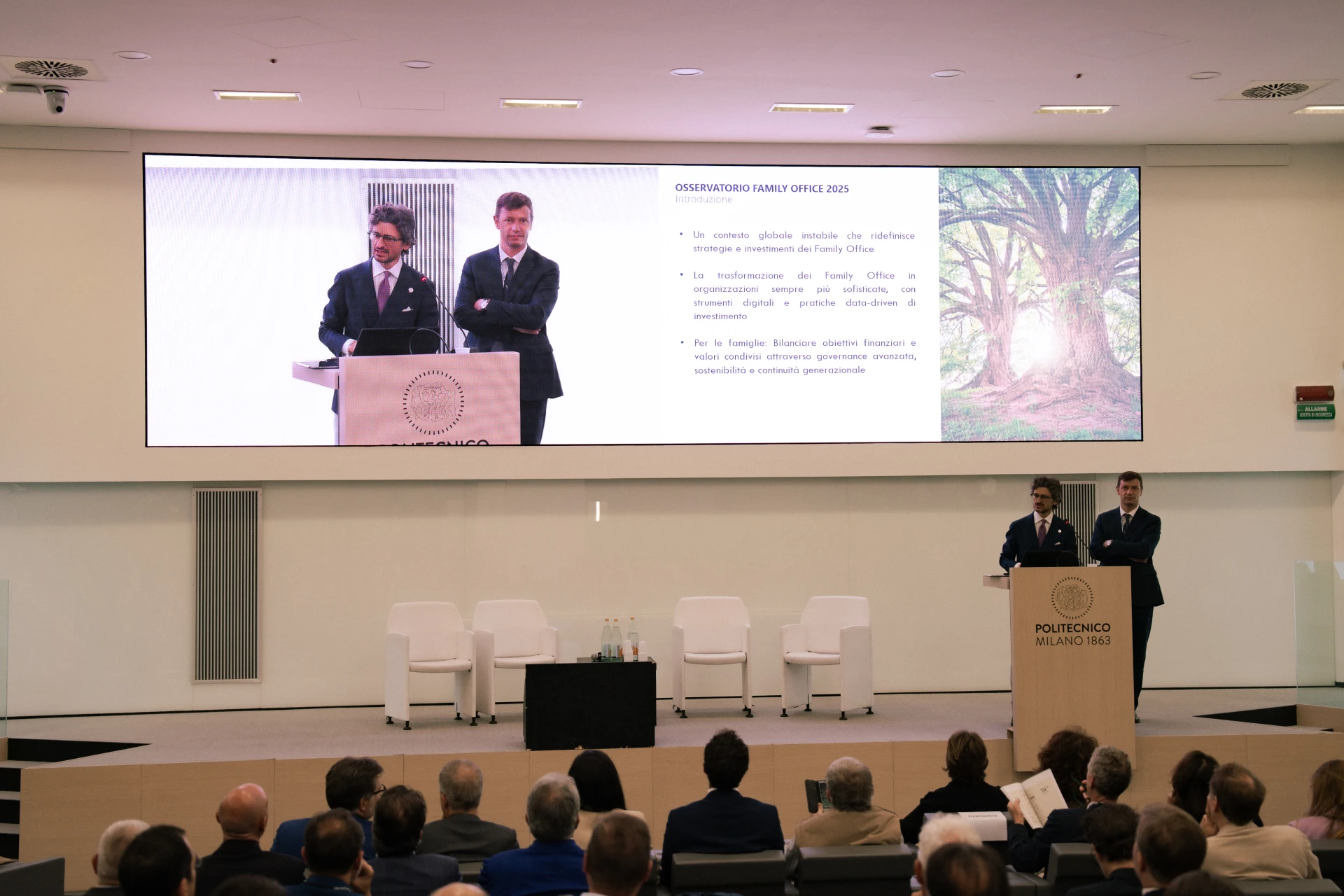
The 2025 edition of the Family Office Observatory of the Politecnico di Milano highlighted this new identity of Italian family offices, true architects of family projects. But also the great ferment in the sector which, as the figures confirm, continues to grow.
As of June 1, 2025, there were approximately 244 Family Offices registered in Italy, divided into 126 Single Family Offices (SFOs), 96 Multi-Family Offices (MFOs), and 22 of banking origin. This represents an increase of +10.4% compared to 2024, reflecting both the vitality of family businesses in the country and the emergence of new structures, often linked to so-called “liquidity events.”
In recent years, however, a paradigm shift has been observed: in most cases, the Family Office is established while the family business is still active, i.e., even before the company’s exit. This is proof that the culture of integrated wealth management is now deeply rooted in families’ habits. This allows the Family Office to become a strategic vehicle, on the one hand to professionalize its approach to wealth, and on the other to give its clients more time to focus on managing business and family dynamics.
The two forces that are reshaping the sector
The metamorphosis of Family Offices is taking place at a historic moment marked by two major forces of discontinuity, which have redefined the global order from various points of view.
The first is technological innovation, with the arrival of AI, which is changing the entire investment cycle as well as wealth management services. The second is geopolitical fragility, which is prompting family offices to rethink the international exposure of their portfolios, also with a view to diversification. Openness to foreign markets and increasingly global networks and interest in more diverse asset classes are becoming the hallmarks of a sector that, while moving towards digitalization, continues to be based on “human” values. Trust and loyalty remain essential for working with an entrepreneurial family.
The Report also highlights the strong propensity of Single Family Offices, at an international level, to build portfolios that include equities (with a share of between 25% and 28%), but also alternative assets, in the face of reduced liquidity.
Italian family offices are also moving in the same direction: private equity remains a central component (22-25%) and real estate continues to play a significant role (13-15%) in portfolios, without forgetting the opportunities offered by the endowment model.
This evidence is also reflected in the habits of family offices, which today, rather than taking a defensive approach, view diversification as a tool to counter volatility and uncertainty. Private equity, venture capital, and ESG investments are increasingly present in their investment strategies. Furthermore, more than half of the investments (53%) remain in Italy, followed by the US (12%), the UK (6%), and other European countries.
Next Gen and family cohesion: the new role of the Family Office
This year’s edition highlighted another important aspect: the involvement of families – and Next Gen – in investment processes. In addition to the essential link between the activities of the Family Office and the cohesion of the family it serves.
The Family Office must, in fact, maintain a delicate balance between keeping in mind the values and guidelines shared in the early stages of the client relationship and adapting to any internal and external changes. In this evolution, the SFO is increasingly becoming a mediator and must be skilled at ensuring a balance between the family’s wishes and its operational and organizational capabilities, according to two key dimensions identified by the report: willingness and ability.
The first, more supportive, involves the active participation of the FO in defining the family’s long-term aspirations and objectives. The second dimension, more operational, is linked to the ability to translate these objectives and aspirations into concrete actions.
Finally, the Observatory also devoted considerable space to the changing world of Multi Family Offices. The research identifies six new configurations—from Multi-Financial and Multi-Technical Offices to Holistic Family Offices—and a network of 118 structures, divided into 96 MFOs and 22 bank-affiliated Family Offices. But there is also a structural trend: strategically choosing which activities to internalize (asset allocation, wealth planning) and which to outsource (technical and legal services). Other activities related to governance, philanthropy, sustainability, and family training, on the other hand, remain in the process of consolidation.
One last interesting fact concerns the preference of Italian Multi Family Offices not to take on the role of a “concierge,” thus distancing themselves from a purely service-oriented approach, typical of Anglo-Saxon markets.
Towards the 2026 Observatory: a metamorphosis still in progress
But the metamorphosis of Family Offices seems far from over. From pieces of a wealth puzzle, they are becoming architects of new family ecosystems, where capital, values, and vision coexist.
And it is precisely in this direction that the 2026 edition of the Family Office Observatory will look, exploring the entrepreneurial vocation of these institutions, as well as their ability to generate growth, innovation, and continuity. Because, like any metamorphosis, that of family offices is a continuous process that generates new forms from existing ones.
Article taken from the December issue of Family Office & Family Business. Subscribe here to read the magazine in print or digital format.