
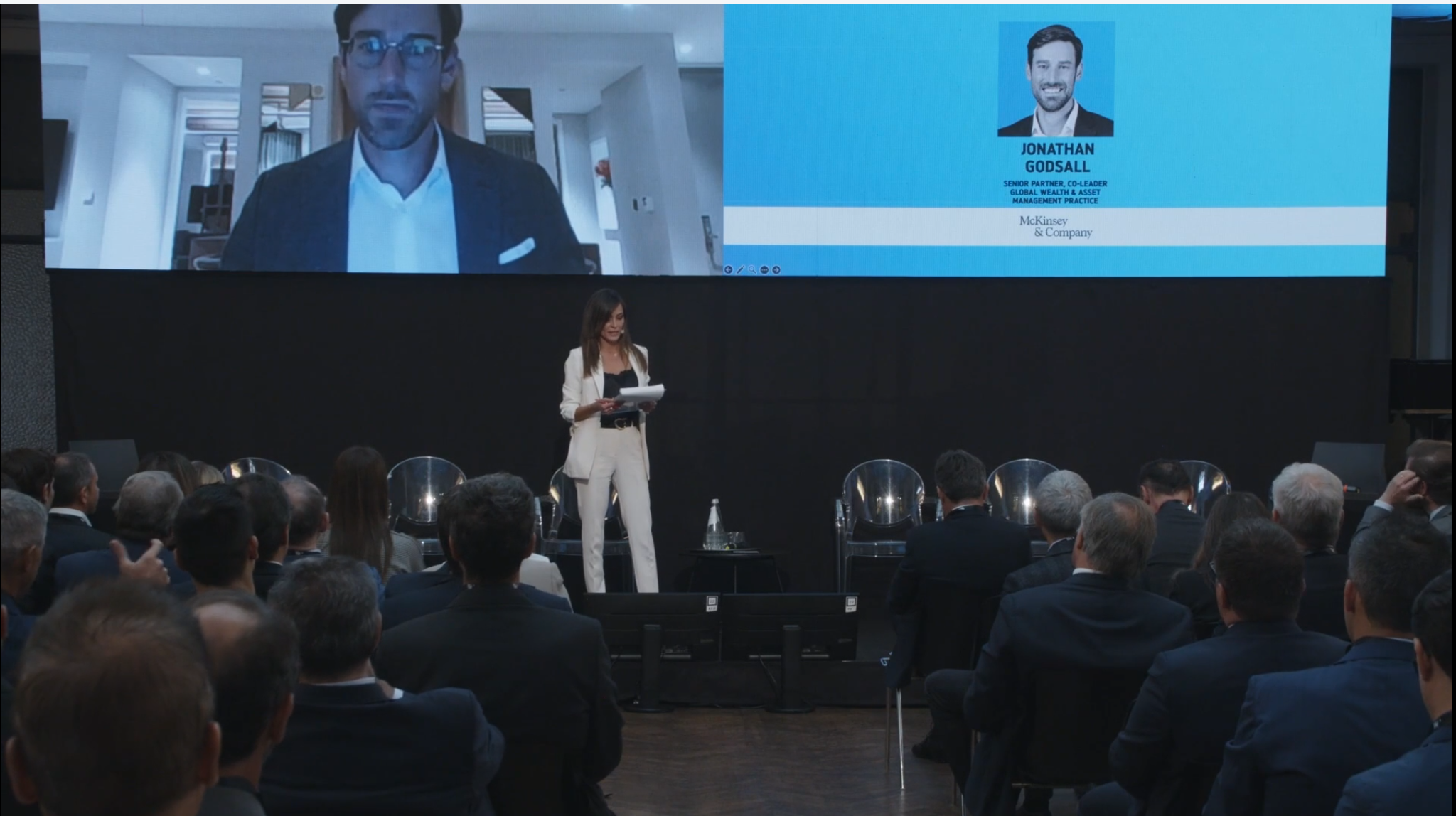
His message was clear: after a period of uncertainty and irregular market cycles, the global asset management industry has entered a new season of growth. The numbers, he pointed out, speak for themselves: revenues up more than 5% per year and average profit margins close to 30%, with a solidity that in 2022—a complex year for asset management—confirmed the sector’s resilience.
Wealth management has shown extraordinary vitality in recent years. This is the picture painted by Jonathan Godsall, Senior Partner and Co-Leader of McKinsey & Company’s Global Wealth & Asset Management Practice, who joined us from San Francisco to open the We Wealth Wealth Management Summit 2025.
Godsall pointed out that sentiment among major international players is now among the most positive it has been in the last decade. Large banks and CEOs of financial groups view wealth management as a stable and strategic area of development, more defensive than other areas of finance, but capable of generating value through direct customer relationships.
A global push from the Middle East to Asia
One of the most obvious transformations, Godsall explained, is the growing internationalization of the sector.
Large sovereign wealth funds in the Middle East, such as Abu Dhabi Investment Authority and Mubadala, have increased their investments in wealth management, adopting a long-term perspective and a particular focus on Asian markets.
At the same time, Singapore has established itself as a new hub for innovation and capital. The speed with which it is digitizing financial services and wealth management has made it a global benchmark, capable of competing with New York in terms of pace and capacity for experimentation.
It is between the Middle East and Asia, he noted, that the new balance of an increasingly interconnected and global industry is beginning to take shape.
Four guidelines for innovating the model
Godsall called 2025 “the year of innovation” for wealth management.
There were four areas on which the transformation has focused and continues to focus:
- Alternatives, with increased exposure to illiquid asset classes, rising from 6–7% to 15–20% in the most sophisticated portfolios.
- Digitalization, with the aim of providing advisors and bankers with tools to improve productivity and customer relations.
- Generational transition, which has required simpler and more intuitive processes to accompany the transfer of wealth to new generations.
- Crypto and digital assets, now an integral part of investment strategies: just think, for example, of Morgan Stanley’s model portfolios, which have included a share, albeit minimal, in Bitcoin.
These four intertwined themes are redefining the strategy of many institutions, from expansion into the private market to the more targeted use of technology, to the transformation of the role of the financial advisor.
The challenge of Gen AI
Alongside structural trends, Godsall emphasized generative artificial intelligence, which was the big news in 2025.
After months of curiosity and skepticism, Gen AI entered the concrete experimentation phase. Major banks and global players began collaborating with Silicon Valley startups to transform pilot projects into operational applications capable of truly impacting business processes.
The goal, he explained, is not to automate customer relations, but to enhance internal efficiency and service quality, freeing up time for higher value-added consulting.
The winning model, he added, is one that knows how to use technology not as a substitute for humans, but as a lever to make them more productive, empathetic, and closer to the customer.
Courage and vision for the new season of wealth management
In the concluding part of his speech, Godsall sent a message of confidence and responsibility: “Now is the time to be bold.”
The combination of structural growth, resilience, and innovation marks the beginning of a new phase of expansion for global wealth management, in which not only the numbers are changing, but also the mindset.
Operators who until a few years ago moved cautiously have adopted more ambitious strategies, paving the way for a more international, technological, and interdisciplinary ecosystem.
With the wind of growth at its back and artificial intelligence as the new frontier, wealth management has entered a phase in which vision, skills, and courage have established themselves as the true drivers of the future.