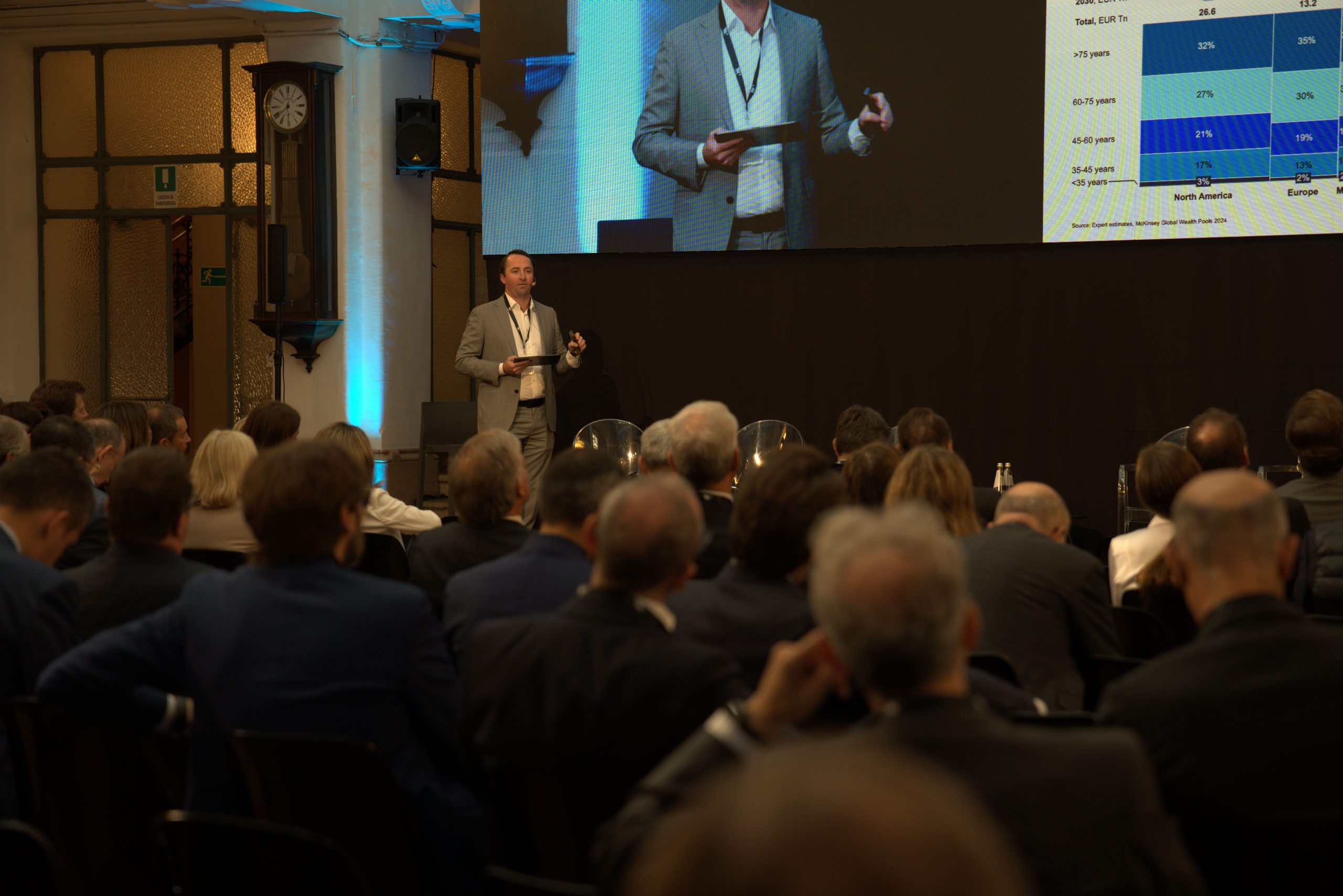
In the United States, personal wealth has exceeded $67 trillion, with a 5% increase among high net worth individuals. But behind these seemingly reassuring figures lies a profound transformation that is reshaping the very way people build, protect, and transfer their wealth.
This was recounted by John Euart, keynote speaker at the second edition of the Wealth Management Summit organized by We Wealth, who offered an unprecedented glimpse into the American market: an advanced laboratory of innovation, but also a warning to Europe about what is to come.
The great generational transition (which is no longer just a promise)
In the United States, 60% of wealth is held by people over 60. For years, there has been talk of the “great wealth transition,” but few have actually seen it happen.
According to Euart, however, the change is already underway—just in a different way than expected: it is no longer an inheritance “at the end of history,” but a progressive transfer during one’s lifetime, he explained.
Parents buy their children their first home, pay for their grandchildren’s college education, and use gifting tools to move increasingly large sums of money in a tax-efficient manner.
This is prompting wealth management companies to cultivate relationships with the next generation well before the age of 22, because those who are not involved at this stage are 75% more likely to change advisors when the wealth is transferred. If the new generation is not already being advised before the age of 22, they are 75% more likely to turn to another advisor when the wealth is transferred.
Independence and value of the advisor
The second revolution starts with business models.
In the United States, advisors have become more powerful than the institutions they work for. When a professional leaves a large wirehouse, they take up to 80% of their clients’ assets with them.
This has fueled the explosion of the RIA (Registered Investment Advisor) phenomenon: independent firms, backed by technology and private capital, which now manage over $10 trillion.
It is an increasingly “hybrid” market, where private banks seek to attract younger clients through digital platforms, while online providers move upmarket with premium services.
This intertwining also changes the way clients are served: less hierarchy, more personalization, more discipline in understanding who to serve and how.
Services, not just performance
To remain competitive, the big names in wealth management are expanding their value proposition by introducing concierge and “personal CFO” services: payments, expense management, coordination with tax advisors and trustees.
Five years ago, this would have been unthinkable. Today, it is almost necessary.
The meaning is clear: defend the value of the relationship by offering integrated experiences, where the client finds a partner capable of solving problems, not just choosing funds.
But for advisors, it also means slimmer margins and a more complex job, involving estate planning, philanthropy, and financial well-being.
Technology yes, but to empower people
The third major transformation is technological, but with a surprising twist: internationally, 80% of companies have invested in artificial intelligence, yet the same percentage has not yet seen concrete results.
Many projects—such as automatic meeting summaries or “next best action” tools—have not cut costs, but have improved service quality.
The most advanced companies are instead rethinking end-to-end processes, such as onboarding, mixing artificial agents and human operators at key moments.
The result? Cost reductions of up to 30-40% and a smoother customer experience.
However, it is not a question of replacing the advisor, but rather of making them more productive, not least because, as Euart explains, 75% of investors with over half a million dollars prefer to pay more in order to talk to a person rather than an algorithm.
Towards a new balance
In terms of products, the US market is moving towards two extremes:
on the one hand, low-cost passive ETFs; on the other, a growing interest in alternative products and personalized tax strategies – active ETFs, direct indexing, managed accounts.
The real innovation today is not the product itself, but tax efficiency and the integration of public and private, which paves the way for unified managed accounts with automatic rebalancing and tax overlays.
The wealth management of the future will therefore be hybrid, integrated, and human.
Advisors will increasingly become “life orchestrators,” helping clients manage not only their wealth, but their lives themselves: health, retirement, goals, and overall well-being.
Automate or humanize? The real question for the future
“We are at the crossroads of the greatest wealth transition in history and one of the most profound technological revolutions of the modern era,” concluded Euart.
Those who only know how to automate will have a temporary advantage, but those who know how to humanize the experience will win in the long run.
Because, in the end, the real technology of wealth management remains relationships.
And the future, at least for now, still speaks human.