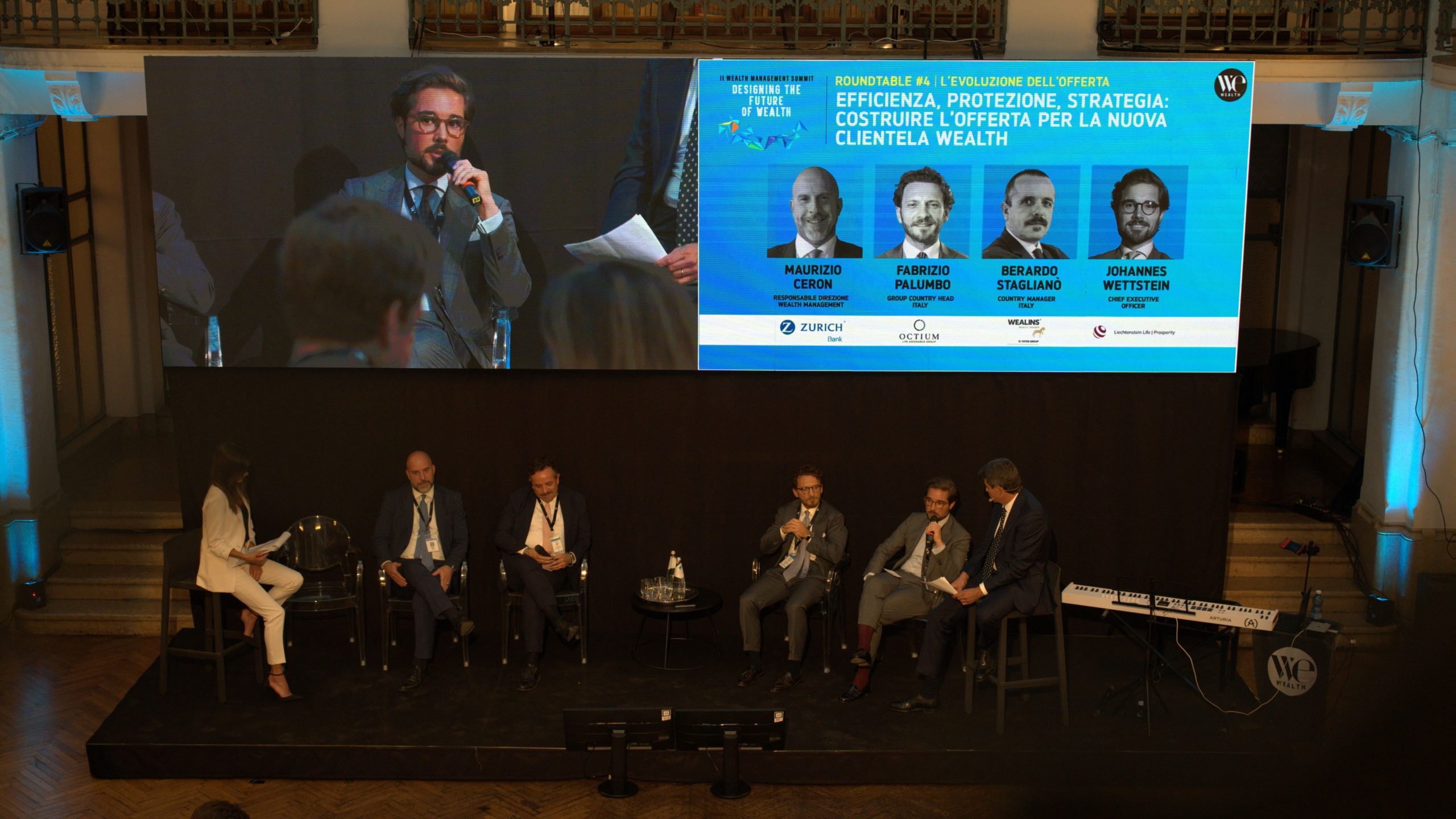
Private insurance is undergoing a phase of profound transformation. From being a tool for confidentiality and tax optimization, it has evolved into a strategic lever for asset planning and family governance, increasingly integrated into wealth management. Insurance companies are addressing this challenge by shifting from a product-centric model to one focused on personalized asset protection, in order to respond to new needs—from generational transition to international policy portability to private asset management—without losing the efficiency of technology or the human value of consulting. All this was discussed at the round table of the 2nd Wealth Management Summit of We Wealth, with Maurizio Ceron, Head of Wealth Management at Zurich Bank, Berardo Staglianò, Country Manager Italy at Wealins, Fabrizio Palumbo, Country Head Italy at Octium, and Johannes Wettstein, CEO of Prosperity Solutions, moderated by Chiara Samorì and Luca Bertacchi, founder and president of The Insurance Academy.
How are insurance solutions changing for wealth clients who are living longer? Are there innovative levers to make them more flexible than in the past?
Berardo Staglianò: “Longevity is an important issue: in Europe, much of the wealth is in the hands of older people, and in Italy, we are often underinsured and late in the generational transition. For this reason, our company has eliminated the maximum age for subscription: today, even at 80 years old, you can take out a policy. In addition, caps on risk capital applied above a certain age can create problems: on a high-value policy, a cap that is too low can expose you to disputes over the insurance nature of the transaction. Here too, we offer tailor-made solutions with a wide range of excess death benefits and options adapted to our clients’ needs. We look not only to the future but also to the present: we have introduced the option of paying an annual coupon, bringing the decumulation typical of retail and affluent clients into the private sector, so as to respond to immediate needs as well as those of transfer.”
A longer-lived clientele also implies new family needs and successors. How can private insurance accompany the greatest generational transition in history and protect new forms of relationships, such as common-law couples?
Fabrizio Palumbo: “We are preparing to face an unprecedented challenge and opportunity: the greatest generational transition in history, worth more than one trillion euros over the next decade. It is a phenomenon that involves the entire private insurance industry, which is called upon to respond with advanced wealth planning tools. Over the last twenty years, we have seen a steady growth in the adoption of our solutions, initially linked to confidentiality requirements or extraordinary transactions such as tax shields or voluntary disclosure.
From the concept of pure distribution to that of protection: how is the service model evolving in dialogue with new generations of customers?
Today, however, private insurance has become an informed choice: the next generation is more informed, more demanding, and more international. It is a generation that will experience this transition firsthand and understand its value, not least because policies allow benefits to be received quickly and confidentially, often reducing family disputes. There is also an equally important social issue. De facto couples and non-marital unions represent a growing proportion of new European families. Private insurance is an extremely effective tool for protecting the surviving partner, because it allows for a direct transfer of benefits without additional taxes and much more quickly than ordinary succession. It is a way to make estate planning more inclusive, modern, and consistent with the reality of today’s relationships.”
Maurizio Ceron: “Over the next ten years, we will see a movement of around €300 billion, not of new wealth but of wealth that will shift from one generation to another. For a company like ours, which founded a bank three years ago, this scenario represents a strategic challenge: deciding whether to invest today to intercept the trend or project ourselves towards the next ten years. The relationship with the customer is already changing. We are developing our model on two fundamental pillars: technology and human capital. On the technological front, Zurich Bank was founded as a fully digital bank: 85% of transactions now take place online, and we aim to eliminate paper altogether. Our advisors have embraced this change, adopting new ways of interacting and building a more immediate and innovative dialogue with customers.
In the United States, in just five years, the role of the financial advisor has changed radically: today they work in teams by specialization and use technology to manage personalized portfolios. That model is also coming to Europe, and we are already integrating it. However, there is another crucial aspect: financial education. It is a process that takes time, but it is essential for clients to become aware of their choices. They need to understand that without risk there is no return, and that protection is an integral part of asset allocation. In this sense, our profession remains a profession of people for people: technology accelerates processes, but it is human dialogue that gives meaning and coherence to advice.”
What is the international view of private insurance from Liechtenstein and Switzerland? What can this model offer the Italian market?
Johannes Wettstein: “The real question we need to ask ourselves is: who will be ready to seize the opportunities of generational transfer and who will let them slip away? We are born digital and believe that to meet this challenge, we need a platform capable of managing large flows efficiently. Paper is no longer a solution: today’s products must be flexible and fast in order to adapt to the needs of increasingly mobile and sophisticated customers. Liechtenstein is a unique financial hub, a bridge between Switzerland and Europe, offering stability, capital protection, and a state-of-the-art regulatory framework on par with the major European markets. It is a country with an AAA rating, no debt, and outside the ESM, all of which strengthen customer confidence.
A concrete advantage for those who move, for example, is the possibility of taking their policy with them: we are the only ones able to guarantee contractual continuity even in the event of a change of residence between Italy and Switzerland. This is a form of real portability, which meets the needs of an international and mobile clientele. Finally, there is an issue that I consider central: family governance. It is a fundamental value for the Italian market and will become increasingly important. Our vision is clear: private insurance must combine flexibility, capital protection, and family governance to accompany assets across time and space.”
Watch the video of the round table
How important is cross-border policy portability for an increasingly international clientele?
F.P.: “The need for international portability is closely linked to the new generation of clients: a more sophisticated, more demanding generation that is accustomed to moving between different countries. Many of them have studied and worked abroad, invest in global markets, and live in different legal and tax environments. For this reason, the ability to transfer and maintain a policy across borders has become an essential requirement of private insurance. Our goal is to offer solutions that accompany the customer across time and space, like a real “asset backpack.” Long-term planning must be able to rely on tools that remain valid even in the event of relocation abroad, without having to redeem the policy or close the structure, with consequent undesirable tax impacts.
The European model, based on unit-linked products, now recognized in almost all EU countries, allows us to guarantee this cross-border continuity. At Octium, we have focused our expertise on this point: offering a platform that allows customers to plan without geographical constraints, knowing that the company will be able to follow them and adapt the policy to their new life and residence. This is the real added value of cross-border portability today.”
B.S.: “There is enormous interest in private markets, but in Italy we are still lagging behind other European countries. According to data from the Italian Private Banking Association (IPB), the share of assets under management invested in this asset class is just 0.9%: a figure that speaks volumes about the untapped potential of the Italian market. In other countries, such as France, private insurance policies that invest in private equity or private debt funds are now standard offerings, typically placed by financial advisors. As a company, Wealins is very active on this front: today, around 10% of our €20 billion in assets are represented by investments in private assets. We have specific tools to integrate this component into policies, such as the Specialized Insurance Fund (FAS), which is unique in Italy and offers a dedicated structuring model.
However, the key point is not only technical: it is cultural. In Italy, there is still a fear that a policy invested in private assets may be reclassified from a tax perspective, but the few cases of reclassification have only occurred in the presence of anomalies in the death benefit. When the policy provides genuine insurance coverage, even in the presence of private assets, the structure remains fully legitimate. In short, private insurance can also be an effective vehicle for alternative investments, provided that it remains faithful to its insurance nature and is used as a long-term planning tool, not as a pure financial vehicle.
How does digitization affect the relationship between companies, bankers, and customers in private insurance?
J.W.: “Digitization is a decisive factor, but it does not mean becoming less human. On the contrary, it serves to restore time and value to consulting. We are born digital, and that does not mean being retail-oriented: for us, digital means precision, speed, and transparency. In the world of private insurance, these three qualities are essential for building trust, reducing complexity, and improving the customer experience. An efficient technological infrastructure allows bankers to devote more time to customer relationships, reducing administrative time. It is a tangible change: with an integrated platform, management becomes more fluid, processes are simplified, and the advisor can focus on what generates real value—personalized advice.
For customers, digitization translates into transparency, speed, and a premium experience, regardless of their level of wealth. Our approach starts from a clear principle: “adapt today to maintain tomorrow’s relationships.” The new generation of customers demands digital efficiency, but also wants to feel supported. Technology, when used well, does not replace human relationships: it enhances them.
Italy remains an underinsured market. Are you seeing a change in demand for protection and how we position ourselves compared to other European countries?
M.C.: “The issue of protection is now at the heart of the growth strategy of the entire banking and insurance system. Today, we see that more and more institutions, including our colleagues at this round table, consider it a pillar of their offering. However, the Italian market remains underinsured compared to Northern Europe, and this is largely due to a lack of financial education. When we ask many customers how they protect themselves, they reply that they keep liquidity in their current account. But liquidity is not real protection: in case of need, that amount may not be enough and, in the meantime, it entails a high opportunity cost. If the risk were covered, the customer could build a more efficient asset allocation and obtain higher returns.
For us, protection is not a product in itself, but the beginning of a dialogue with the customer. It is the foundation on which everything else is built: health coverage, supplementary pensions, financial planning.
At Zurich Bank, we have introduced a dedicated solution, leveraging the group’s international experience, and made it an integral part of the advisory process. But it is always human capital that makes the difference. We may have the best products in the world, but if our advisors do not internalize this logic, we will not be able to truly bring it to our clients. At the end of the day, our business remains a business of people for people.”
What will be the most important innovations in private insurance in the future?
B.S.: “Innovation does not just mean digitalization. I believe that in recent years there has been too much focus on technology and too little on product development. We need to go back to offering new options to customers, such as the possibility of converting the policy into an annuity, a solution that could respond concretely to the needs of those seeking stability and long-term planning.”
F.P.: “Looking at the experiences of other countries we serve, we see more widespread use of non-standard assets and greater exposure to demographic risk, as is the case in some Asian and American markets. It would be desirable to be able to integrate these components into our models as well, to further enrich the range of tools available. Of course, this will depend on the regulatory environment, but it is an evolution that needs to be put on the agenda.”
M.C.: “The real challenge is to also grow Italian law solutions. Our legislation offers solid protections for clients, and combined with a path of product innovation, it can become a competitive element compared to the main European hubs. In short, we need more competition and more evolution in the domestic market.”
J.W.: “I agree with those who say that the human aspect remains central. Digitization serves precisely to free up time and resources for consulting. In banking, we used to spend half our time on administrative tasks: today, we can devote that time to customers. The foundations of our business—capital protection, family governance, tax optimization—will remain the same even in ten years. What will change are the means: products will have to be more global, more flexible, and more digital.”