

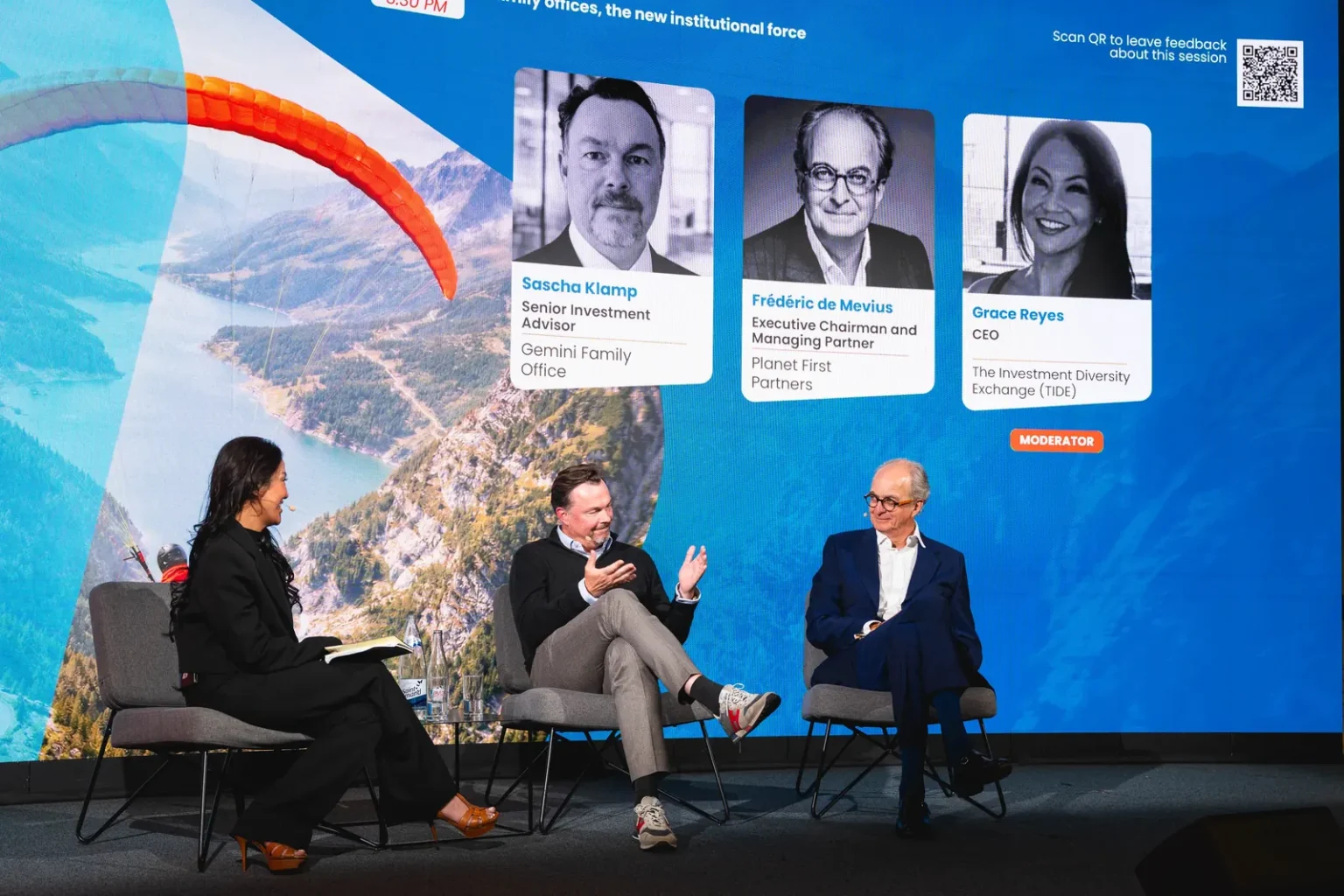
They have no ten-year fund terms to meet and no fees to justify, yet they operate with the same sophistication as major funds. Family offices are “the new institutional force” in private markets, at least according to the title of a panel held on September 10 at IPEM Global 2026 in Paris. Moderated by Grace Reyes, founder and CEO of The Investment Diversity Exchange (TIDE), the panel brought together two investors with very different backgrounds. On one side was Frédéric de Mévius, executive chairman and managing partner of Planet First Partners and a scion of one of the families behind AB InBev. On the other was Sascha Klamp, senior investment advisor at Gemini, the family office of a major Egyptian industrial family. The discussion painted a picture of patient investors increasingly drawn to direct investments.
Four centuries on tap – and a lesson in diversification
De Mévius begins with his family’s origins. His family has been in the beer business for four centuries and, through a series of mergers and acquisitions that began in the late 1980s, helped build the world’s largest brewer, which today produces roughly one in every four beers consumed globally. Success, however, came with a downside: an overly concentrated fortune. This led, in the mid-1990s, to the creation of Verlinvest, the family’s first investment vehicle. Today, alongside its equity holdings, the family has adopted a multi-asset strategy. The goal, he explains, is to professionalize its approach and move closer to the model of endowments, the investment funds of major American universities.
Europe is still wary of equities
What distinguishes European capital from American capital? For De Mévius, the answer can be seen in valuations, which are lower in Europe across all equity segments. The key issue is where savings end up: in Europe, they are primarily directed towards bonds and credit, while in the United States around 55% flows into the stock market. Without a deeper European equity market, he warns, Brussels’ efforts to finance growth will achieve little.
Klamp starts from a different question: what is our money doing to create jobs in the real economy? According to the European estimates he cites, around €1.4 trillion remains sitting in deposits without reaching small and medium-sized businesses. For the family he advises, this is not an abstract issue: companies within the group employ around 400,000 people worldwide. Creating jobs, he explains, is what drives the family, now in its third generation.
Family offices face the test of private markets: a bank just for SMEs
The concrete response was to acquire a bank and turn it into a specialized lending platform: no retail clients, no private banking, just loans to SMEs ranging from €1 million to €5 million, preferably secured by assets. Small businesses, Klamp observes, support a large share of employment across Europe but remain underserved: growth capital and venture debt are in short supply, while traditional banks are reluctant to finance companies without revenues or demand excessive guarantees from founders. The target is to reach €10 billion in lending, in a potential market that Klamp estimates at €100 billion. It is a 20- to 50-year project, he acknowledges.
Family offices in private markets: not just investors, but operators
So what sets them apart from funds? Klamp’s family office typically takes controlling stakes and assumes board-level governance responsibilities: this is its way of managing risk. But it also acts as an operating partner, drawing on the expertise of the group’s many businesses while working alongside external advisors to validate business plans.
Family offices backed by an operating business or created after a liquidity event?
De Mévius adds a useful distinction: there is a difference between family offices backed by an active industrial business and those created after the sale of the family company, following what is known as a liquidity event. The former can provide portfolio companies with industry knowledge, relationships and execution capabilities; the latter have to build these resources from scratch and consequently tend to look more like traditional funds.
The keys to Bugatti
This is where the deal that got the panel talking comes in. The closing, Klamp explains, had taken place just one day earlier, with the family playing a leading role: Porsche sold its stake in Bugatti Rimac for around €1 billion to a consortium led by Hof Capital, the investment firm co-founded by Onsi Sawiris, son of Naguib Sawiris. It was not a trophy asset to be displayed, Klamp stresses, but an asset under pressure, sold by a group in need of liquidity amid turmoil in the automotive sector. More than a year was required to complete the deal, with much of the work focused on legal matters, starting with intellectual property. During lengthy negotiations with Porsche and Volkswagen executives, the goal was to obtain “the key, not just the house.” The bet is on the brand’s heritage.
When value was going down the drain
De Mévius responds with Vita Coco, one of Verlinvest’s best-known investments. The brand was right and the product compelling, but unlocking value required something else: securing exclusive, long-term supply agreements around the world, from Brazil to the Philippines. Coconut water, he recalls, had previously been simply discarded. It became a defensive moat – a hard-to-replicate competitive advantage that the family looks for in every investment. It can be a brand, a recipe or control over the supply chain. The advantage of family offices, he adds, is that they can stay invested for longer. In the case of Vita Coco, the investment lasted twelve years, with the company going public halfway through the journey. Part of the stake was retained, and the value of the investment is now estimated at several billion. The same principle guides Planet First Partners, the growth equity platform he founded in 2020: companies with strong, defensible intellectual property. Among its investments are three or four companies involved in quantum computing.
The flexibility of club deals
For De Mévius, the future lies in deals structured among families – so-called club deals. An increasing number of family offices are prepared to act as lead investors, taking responsibility for managing other people’s capital without charging fees, knowing that the next deal will probably involve the same people in a different configuration. Klamp agrees, but with a caveat. Unlike the relationship between fund managers and investors, which is governed by established agreements negotiated by third parties, bilateral co-investments between families still lack a legal and governance infrastructure. Between families, there are no polished presentations – only ideas and mutual trust. He jokes with his fellow panelist that he would have happily sold half of the Bugatti stake, but neither of them called the other. Once this issue is resolved, he predicts, significant volumes of capital will be unlocked and competition among managers will become fiercer.
Wanted: “curious” minds – the edge over AI
The two investors also differ when it comes to talent. De Mévius draws from the same talent pool as private equity: sophisticated professionals with expertise in the sectors where the family invests directly, capable of accelerating growth while containing risk. His advice to young people is to spend their free time between internships working on the ground, in order to become “street smart.” Klamp, by contrast, puts the emphasis on curiosity. Family offices need people who are always willing to ask the next question and to say, “I disagree” – the only way, he argues, to compete with artificial intelligence.
Allies or rivals to traditional funds?
The final question is straightforward: are family offices complementary to, or competitors of, institutional investors? Complementary, both agree, but with some important distinctions.
Klamp points to a difference in investment horizons: funds typically think in terms of ten years, while his family looks beyond 25 years. De Mévius, meanwhile, expects the share of family wealth allocated to funds to decline as families increasingly pursue direct investments. The allocation could, he suggests, fall from 20% of assets to 10%. “Completely complementary,” he concludes. At least for now.