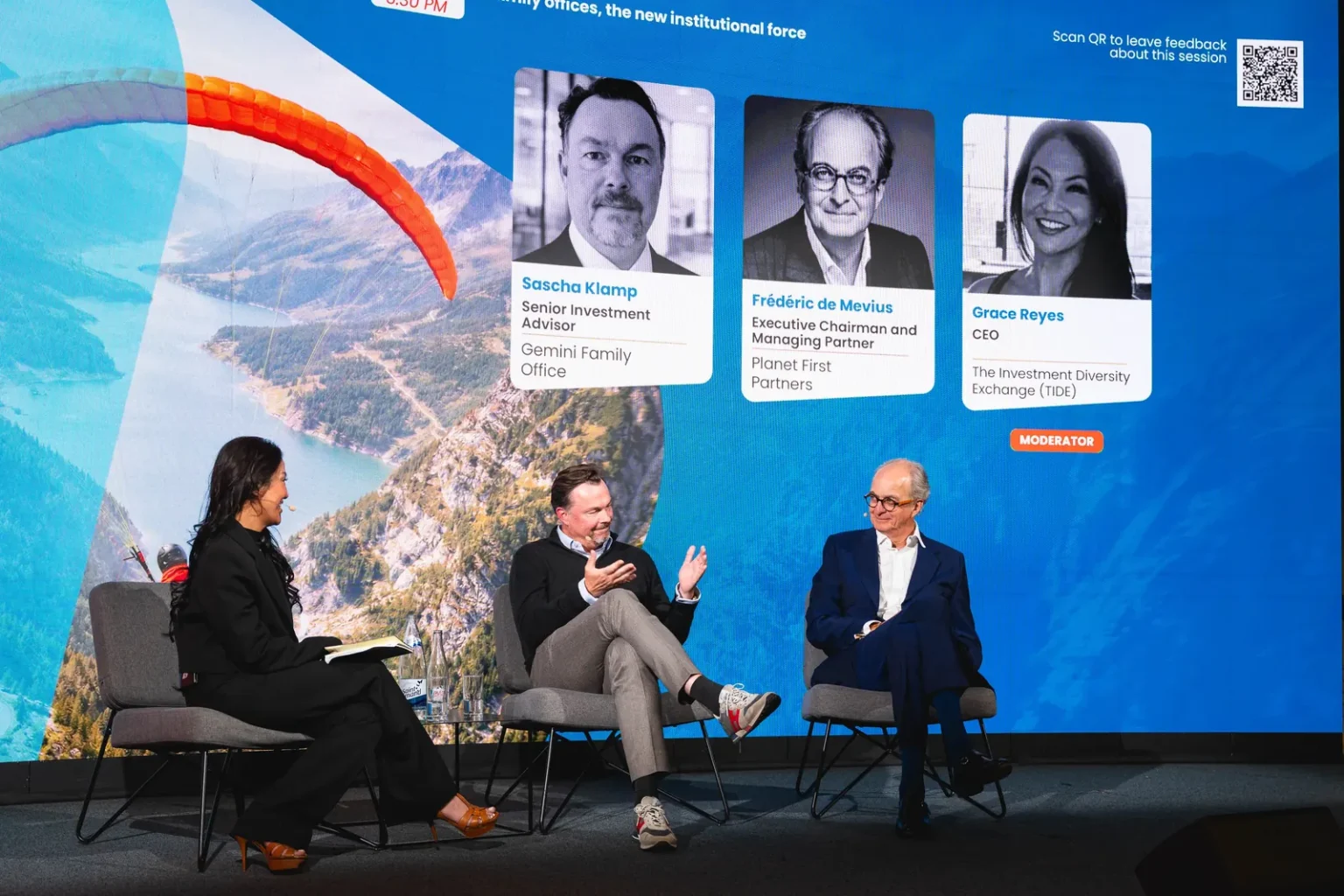


“Strong Europe” is the theme of the third edition of 0100 International, the private markets conference organised by Zero One Hundred Conferences. Running until tomorrow at Palazzo Castiglioni, the headquarters of Confcommercio Milano, the event brings together around 700 private equity and venture capital decision-makers, with more than 120 speakers from over 50 countries (We Wealth is among the media partners). The afternoon of the opening day brought three questions into focus that, on closer inspection, boil down to one: where can European venture capital truly make a difference in a world that is ageing, rearming and racing to embrace artificial intelligence?
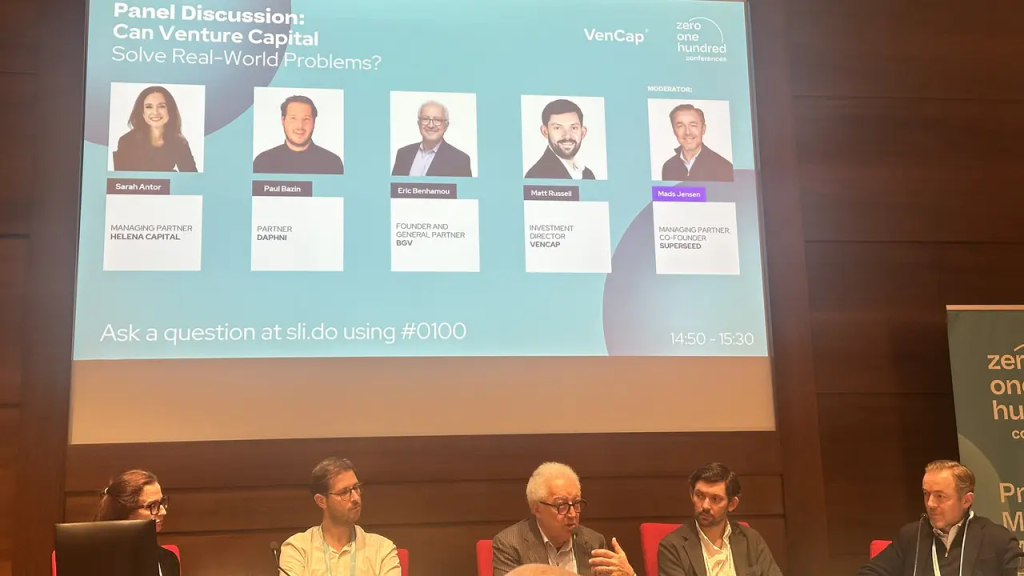
From left to right:
Sarah Antor (Helena Capital), Paul Bazin (Daphni), Eric Benhamou (Bgv), Matt Russell (VenCap) and Mads Jensen (Superseed, moderator). Photo by Teresa Scarale.
Demographics and Healthcare: betting on assisted reproduction and metabolic health
The first panel, dedicated to healthcare technologies, longevity and biotechnology, opened with a demographic statistic. A fertility rate of at least 2.1 children per woman is needed to maintain a stable population. The rate stands at 1.6 in the United States, 1.3 in Europe, 1.1 in Japan and 0.75 in South Korea. “One of the biggest existential problems facing Western democracies, which we do not talk about, is depopulation,” said Aike Ho, general partner at Acme Capital. A healthcare system without enough doctors and nurses also undermines the social contract: “If healthcare does not work, a large part of the state does not work.” Ho identified two investment priorities. The first is to make having children easier by applying robotics and computer vision to in vitro fertilisation, reducing costs and increasing success rates. The second is to automate tasks for which demand now exceeds supply, starting with surgery. Looking at the other end of the life cycle is Christina Ulardic, partner at Astanor. Since the 1960s, life expectancy has increased by around 20 years, but the ratio between years spent in good health and years spent ill has remained roughly at half: for every additional year of life, half a year is spent with at least one chronic condition. According to Ulardic, the key issue is metabolic health, which is compromised in approximately 90% of US adults and around 60% of Europeans, with research also linking it to cancer and dementia.
The question of scientific sovereignty
Scientific sovereignty is another key issue. According to estimates by Efpia and Iqvia, Europe’s share of commercial clinical trials worldwide fell from 22% in 2013 to 12% in 2023, as studies increasingly shifted towards China and Australia. “This is not something we should accept,” warned Alexis Houssou, founding and managing partner at Hcvc. Where clinical evidence is generated is ultimately where drugs are brought to market. A faster, less expensive system is needed, including through virtual cell models that can be used to test molecules. What about artificial intelligence? Houssou avoids companies that train models on publicly available datasets, which can easily be replicated, and favours those with proprietary data. Ho, meanwhile, points out that many AI-driven drug discovery start-ups founded five to seven years ago found themselves taking on an entirely different business once they had identified a molecule: clinical development, a process that can take 15–20 years. In the short to medium term, robotics offers a more attractive proposition by automating tasks that companies already pay for, with exit opportunities compatible with a fund’s ten-year lifespan. It also offers an unexpected competitive advantage: in the age of AI, “revenue is cheap” and comes and goes, whereas in healthcare, regulation forces every competitor to repeat clinical trials and obtain the necessary authorisations.
Dual-Use technologies: the convergence of venture capital and defence
At a panel sponsored by VenCap and moderated by Mads Jensen, co-founder of Superseed, the question was whether venture capital can solve real-world problems. Paul Bazin, partner at Paris-based Daphni, explained that the fund assesses every investment against the UN Sustainable Development Goals. For now, defence remains outside its investment thesis, while energy—which is also a matter of sovereignty—has long been part of it. Eric Benhamou, founder and general partner at Bgv, based in Menlo Park, takes the opposite view: “Our mandate is to maximise returns for our investors.” Growing defence budgets, he argued, are not a short-term phenomenon. This has led to the creation of a dedicated dual-use unit based in Israel, which adapts military research for civilian applications.
One example is reinforced drones capable of carrying up to 50 kilograms of sensors to inspect refineries and power plants, replacing human inspection teams. For Sarah Antor, managing partner at Helena Capital, the product often remains the same; only the label changes. A Munich-based company originally established to serve ports, operating in environments where satellite signals are disrupted, has received enquiries from the French, German and US defence ministries. An exoskeleton designed for surgeons has become part of Nato’s Diana programme. Even a video game company has been approached by the Pentagon.
Waste in the era of zero interest rates
Matt Russell, investment director at VenCap, brought the discussion back to the numbers. VenCap is a fund-of-funds that has been investing in venture capital funds for around 40 years and has selected approximately 500 of them. Its data show that the top 1% of exits account for roughly half of the capital returned by the entire industry. Repeating the calculation for the past eight years pushes that share to 55%. This concentration explains the fund’s focus on the strongest generalist managers. Impact, Russell added, often comes from unexpected places. Consider the air miles saved through the use of a videoconferencing platform such as Zoom. More capital is not enough, Benhamou warned. During the years of zero interest rates, money was abundant and, as an industry, “we wasted most of it”. Quality entrepreneurs are in short supply.
Cost arbitrage: Europe’s advantage in engineering and talent
The question of scale remains, often prompting European founders to move to the United States. Antor, an American who has lived in Europe for 20 years, sees an opportunity for arbitrage instead: undervalued European technologies and an industrial base, particularly German engineering, that is lacking across the Atlantic. With offices in Munich and New York, the fund invests approximately 30% of its capital in US companies. It also seeks to connect start-ups with major industrial and defence groups that could become both customers and acquirers. Benhamou sees the arbitrage opportunity in talent. For equivalent skills, an AI specialist with a PhD costs six times as much in Silicon Valley as in Bangalore and approximately twice as much as in Western Europe. Its impact can be summed up in one line: “Produce more while consuming less.” In parallel, a panel on artificial intelligence, moderated by Geri Kirilova, partner at Laconia, opened with a figure highlighted at the start of the conference: AI now absorbs almost two-thirds of global venture capital. Among the speakers, Briehan Burke, general partner at Keen Venture Partners, is betting on software that replaces services. Small and medium-sized enterprises spend little on software licences but substantial amounts on lawyers and consultants. AI can therefore sell the completed work rather than the tool used to produce it. Pedro Santos Vieira, partner at 500 Global, takes a similar approach, seeking teams capable of owning an entire workflow. One portfolio company operating in the relatively unglamorous debt collection business has replaced its entire workforce in Peru with an AI agent. Daniel Minchin, investment director at OurCrowd, takes a more cautious view of inflated late-stage funding rounds. He prefers traditional companies, from cybersecurity to industrial companies, that use AI to improve their margins.
Where AI capital is concentrated and the risk of a bubble
Jose Marin, co-founder of FJ Labs, distinguishes between three categories of companies: those valued on promises rather than revenue; those growing at unprecedented rates but with uncertain margins; and those combining rapid growth with solid margins. In his view, only the last category will endure. The cracks could begin to appear when the revenue expected by major model developers materialises later than anticipated, leaving excess capacity and driving prices down. As for Europe, Marin, who identifies as Southern European, points to a cultural barrier even before regulatory constraints come into play. In countries such as Spain and Italy, failure can carry consequences for years, while the social stigma remains enormous.
“How can we accept failure the way it happens in the United States?” he asked.