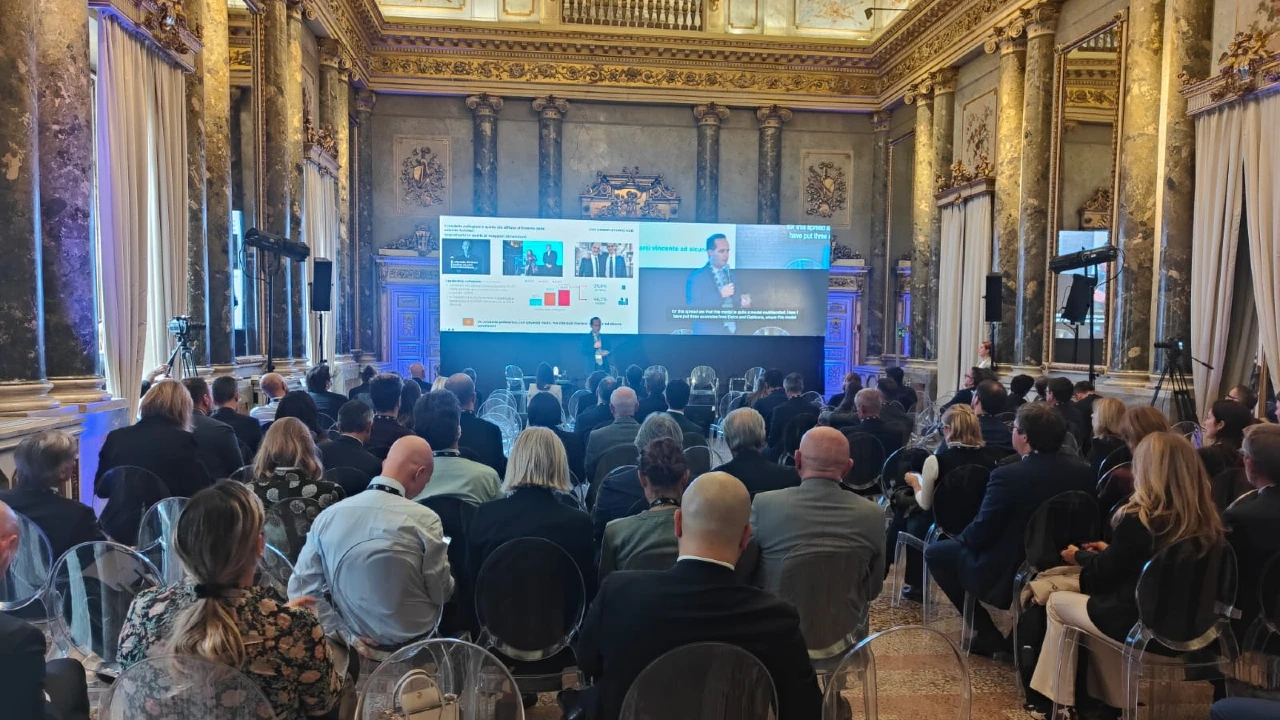
More than one in three family-owned businesses will have to navigate a generational transition over the next 10 years. This figure could rise to almost one in two if the change of generation takes place when the current leader reaches the age of 70. These are the findings of the 17th edition of the AUB Observatory (Aidaf – UniCredit – Bocconi), presented by Fabio Quarato, managing director of the Aidaf-EY Chair in Family Business Strategy at Bocconi University, during the 2026 Wealth Management Summit, held on 8 October at Palazzo Serbelloni in Milan.
Generational transition: when and how to prepare for succession
According to the Observatory’s estimates, between 2025 and 2034, 33.5% of family-owned businesses with revenues exceeding €20 million could undergo a generational transition, assuming the senior generation steps down at the age of 75, the current average age at which they do so. The figure would rise to 48.8% if the transition took place at 70, in line with what is considered best practice.
However, the most interesting finding is not simply how many companies will face a leadership change, but also what happens afterwards. The AUB Observatory’s analysis shows that, when managed effectively, generational succession can positively affect business performance, increasing return on assets (ROA) by 4.2% and revenue growth by 8.8% over the following three years. The key question, therefore, is not just when to pass the baton, but how to prepare for the transition. The way succession is managed appears to be decisive. Over the past 15 years, 33.6% of generational transitions have involved a mentoring process, with the outgoing leader supporting the NextGen successor or successors before handing over leadership. In 2024 alone, this share had already risen to 44.4%. The criteria used to select successors are also changing.
The Observatory shows that 27% of designated NextGen successors hold a higher educational qualification than other potential candidates. Among women, the figure rises to 32.1%. Merit also appears to translate into stronger results: a higher educational qualification than that of other candidates is associated with a 25% increase in ROA and a 29.4% increase in return on equity (ROE). By contrast, being the firstborn child is associated with a 16.6% decrease in ROA and a 37.3% decrease in ROE. Succession, therefore, appears to be moving away from a purely dynastic model towards one based on skills, preparation and mentoring. This shift is part of a broader transformation in family business leadership: family members remain the dominant choice, but their share is gradually declining.
From generational succession to family governance
Generational succession is no longer simply a matter of choosing the next leader. It has become a question of governance, expertise and relationships within the family. At the 2026 Wealth Management Summit (WMS26), Manuela Soncini, CEO of Cordusio Fiduciaria and head of UniCredit Wealth Management and Private Banking’s Business and Family Advisory team, addressed this shift from the perspective of entrepreneurial families’ needs. Preparation is a central issue. If such a significant proportion of businesses is expected to undergo a leadership transition over the next decade, the question is how ready families will be when the time comes. This applies not only to corporate structures, but also to wealth and family relationships. A generational transition can simultaneously reshape corporate governance, relationships among family members, the structure of family wealth and relationships with financial intermediaries.
When a business becomes wealth: the Pesenti family case
Succession was then examined from a different perspective: not simply who will take the place of the previous generation, but what happens when a family decides to part ways with the business that has defined its identity for generations. This was the case explored by Giulio Pesenti, head of corporate strategy and business development and board member of Clessidra Group, drawing on the history of the Pesenti family and the sale of Italcementi. For an entrepreneurial family, selling a business does not simply mean converting an industrial stake into cash. It also means redefining the relationship between the family, the business and its wealth. The real question becomes what happens “the day after”: deciding what to build when the company that has been at the centre of the family’s identity for generations is no longer part of its assets. This also requires a shift in expertise. Being a successful entrepreneur does not automatically mean being a professional investor. The transition can gradually lead towards direct investments, private markets and new capital allocation models. However, it also requires families to learn how to manage wealth that is no longer tied to the business itself.
Before the exit: why entrepreneurs must plan their wealth
This was the issue addressed by Gianluigi Serafini, equity partner at GA-Alliance. In many cases, the paradox is that entrepreneurs may have most of their wealth concentrated in their business without fully recognising it as part of their financial wealth. The result is a double concentration of risk: on the one hand, entrepreneurial risk; on the other, a substantial share of personal wealth tied to the same asset. For wealth advisors, this changes the perspective. Managing an entrepreneur’s financial portfolio without understanding the value and risk of the business they own means looking at only part of their overall wealth. Wealth planning should therefore begin before the exit, while the entrepreneur is still running the business and can consider diversification and future liquidity.
After the exit: building a new wealth identity
Once the sale takes place, the challenge changes again. Rinaldo Sassi, founder and CEO of Scouting, examined the entrepreneur’s second act: the period that begins when the business is sold and wealth previously concentrated in the company suddenly becomes liquidity that needs to be invested. The entrepreneur must then learn a different profession. Within their own company, they understood the market, management and operational dynamics. As an investor, however, they may find themselves acting as a minority shareholder, limited partner or co-investor, without direct control over decisions. This is a cultural transition that also affects risk management. Following a liquidity event, there may be a temptation to reinvest quickly and continue seeking the active role of an entrepreneur. The real challenge, instead, is to build a long-term wealth strategy, deciding how much capital to allocate to individual investments and how to diversify their wealth.
Family offices and AI: who governs wealth complexity?
Complexity increases further when family wealth is no longer concentrated solely in a business or financial portfolio. In a discussion between Tiziana Leone, co-founder and wealth manager at Ataraxia Management, and Roberta Crivellaro, managing partner at Withers Studio Legale, the focus shifted to the challenge of coordinating wealth comprising equity stakes, cash, real estate, investments and assets spread across multiple countries. The problem is not necessarily a lack of advisors. On the contrary, it may be the presence of numerous specialised professionals without a single party capable of maintaining an overall perspective. Artificial intelligence adds another layer of complexity. Clients increasingly approach professionals with information, analyses and documents already prepared using technological tools. This changes the value of advice: less emphasis on producing information, and more on interpreting and verifying it, as well as taking responsibility for the resulting judgement. The same applies to family offices. Technology can make it easier to maintain an up-to-date overview of family assets, but it cannot replace governance, mediation skills or a long-term vision.
Private insurance: its role in wealth structuring
The event continued with a contribution from Fabrizio Novelli, senior family officer at Amgest SA, who turned the discussion towards private insurance. When wealth involves multiple banks, asset managers, assets and jurisdictions, an insurance policy can serve a more complex purpose than its traditional roles in protection, estate planning and tax deferral. The discussion also covered mechanisms such as multi-booking and multi-manager arrangements, as well as the relationships between insurance companies, custodian banks and asset managers. The objective is to understand whether, when properly governed, the greater complexity of a wealth structure can also provide an additional layer of control and diversification.
Generational transition: family wealth goes global
Generational succession in an increasingly complex environment, together with the tools available to wealthy families, was subsequently discussed by Marco Cerrato, partner at Maisto e Associati; Alberto Cirillo, managing director and co-head of Southern Europe Private Wealth Management at Goldman Sachs; Giovanni Ronca, head of UBS Global Wealth Management Italy at UBS Group; and Roberto Pellizzari, equity partner at LCA Studio Legale. The starting point is that succession involving substantial wealth can no longer be treated solely as an inheritance matter. Families are increasingly international, younger generations may live in countries other than their country of origin, investments are spread across multiple jurisdictions, and wealth can be structured through companies, holding entities, investment vehicles, trusts and other instruments. The profile of high-net-worth (HNW) and ultra-high-net-worth (UHNW) clients is also changing. On the one hand, new entrepreneurial families and generations of business founders are emerging, including in the technology and digital sectors. On the other, established wealthy families must navigate the Great Wealth Transfer, with the NextGen seeking greater involvement in governance and wealth-related decisions.
The great wealth transfer: the NextGen wants a role in governance
The transition to a new generation is not simply about ownership of assets. It concerns who makes decisions, how those decisions are made and which rules govern the process. Governance becomes particularly important when a family spans several generations, heirs have different tax residences, or wealth is spread across corporate holdings, financial investments and businesses in multiple countries. In this environment, the role of the wealth manager expands beyond investment management to include coordinating the different components of a family’s wealth and working with tax and legal professionals. Family holding companies can also become a central part of the wealth structure, particularly when they need to be aligned with governance requirements and succession planning.
Trusts, holding companies and international mobility: succession across borders
From a tax and legal perspective, the growing international mobility of families introduces additional layers of complexity. Different tax residences, heirs living in multiple countries and internationally diversified assets require careful consideration of the implications of the various structures used to organise and transfer wealth. The panel also examined the role of different vehicles, particularly family holding companies, as well as the possibility that a structure’s tax residence may be deemed to be in Italy. This makes the need for early planning even more apparent: succession and corporate structures must form part of a comprehensive strategy rather than being introduced only when the generational transition is imminent.
From succession to the purpose of wealth: women and philanthropy
The transformation also concerns who makes decisions and what they want to achieve with their wealth. The panel discussed the growing role of women as decision-makers within UHNW families and the increasing importance that younger generations attach to philanthropy. Wealth is therefore no longer viewed solely as capital to be preserved and transferred. For a growing number of families, it is also a tool for pursuing social and philanthropic objectives. This raises further questions about governance and structure. Foundations, third-sector organisations (Italian Third Sector entities) and charitable trusts can serve different purposes and require careful assessment, including from a tax perspective.
Generational succession: what is the first step?
In a nutshell, if a family were to start preparing for its generational transition today, what should it do first? The answer emerging from the different perspectives shared at the Summit converges on one key principle: start early.
Private insurance: preserving wealth continuity after generational succession
The thematic programme concluded with Johannes Wettstein, chief business officer at Liechtenstein Life, prosperity and CEO of Prosperity Solutions AG, who returned to private insurance as a potential component of the wealth structures used by international families. When tax residences, banks, asset managers, investments and beneficiaries change, maintaining continuity of wealth becomes a central concern. The objective, however, is not to indiscriminately place every asset within an insurance policy. It is to determine which components of a family’s wealth can effectively be incorporated into the structure and what added value private insurance can provide for families and assets that are increasingly mobile across borders.
Conclusion
The AUB Observatory’s figures show that generational succession is already a structural phenomenon and is set to become more widespread. The growing use of mentoring suggests that families are increasingly recognising the need to prepare for succession well in advance. At the same time, the growing complexity of family wealth makes it increasingly difficult to separate business succession from the transfer of family wealth. In other words, generational succession does not begin when the name of the CEO changes. It starts much earlier: with the selection of the NextGen’s skills and capabilities, family governance, wealth diversification and the development of relationships between generations that can endure beyond the business itself. This is precisely the challenge highlighted by the 2026 Wealth Management Summit: supporting families that, over the coming years, will need not only to transfer wealth, but also to decide how it should be governed, who should manage it and what role it should play in the family’s future. Family wealth is becoming increasingly complex, and its transfer requires more time, stronger governance and greater coordination.