
After years of substantial stagnation, the real estate market is starting to move again. But it is not a widespread recovery. Major capital is returning cautiously, concentrating on a few operations of significant size and on assets that are difficult to replicate. Rather than a recovery, it is a selective reopening of the market, driven by investors with long horizons and equity availability.
Real estate market: the return of major capital starts from premium assets
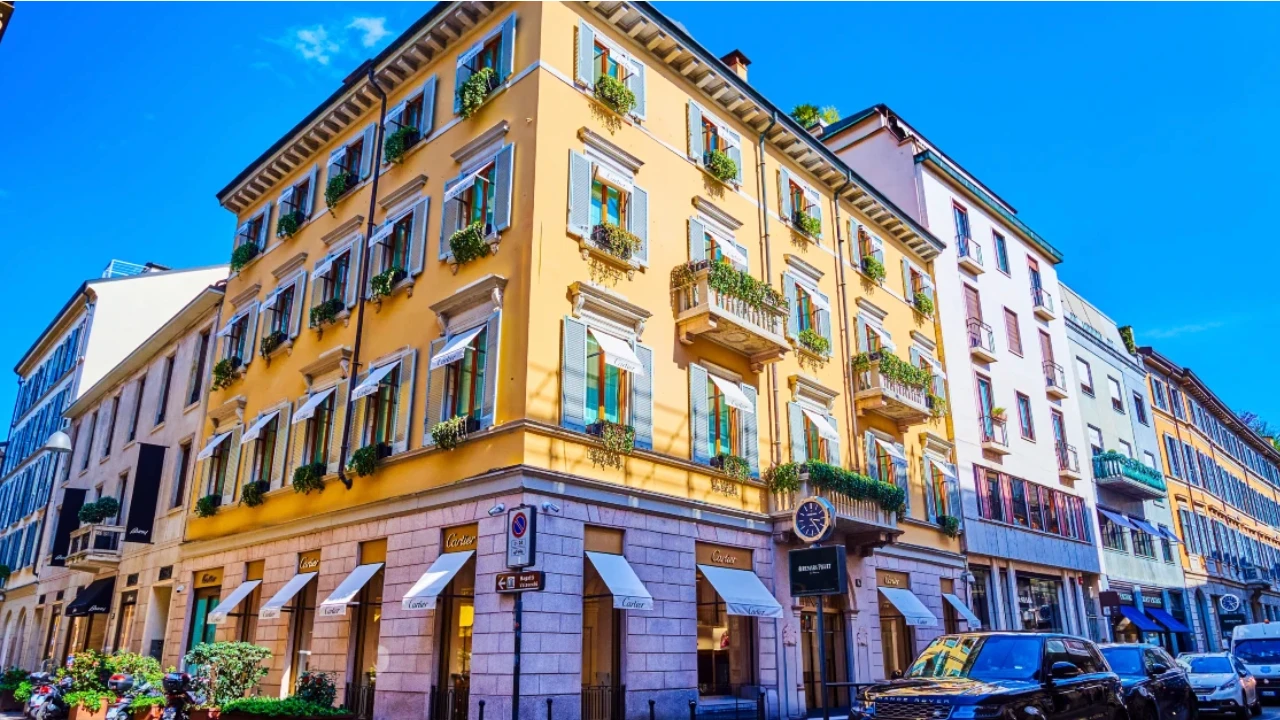
In this context, some operations take on emblematic value. This is the case with the building at Via Monte Napoleone 8 in Milan, in the heart of the luxury district, acquired for approximately 1.3 billion euros by a vehicle traceable to Qatari capital. In practice, at the beginning of April 2026, Kering announced the conclusion of a settlement agreement, with immediate effect, with Al-Mirqab Group, for the iconic eighteenth-century property at Via Monte Napoleone 8, of which it is the owner, contributing the asset to a newly established joint-stock company, held 80% by Al Mirqab Group and 20% by Kering itself.
A record deal for the Italian market, which confirms that international capital has returned to allocating resources to European real estate, but exclusively on trophy assets, characterized by uniqueness, global demand and limited supply.
This is not an isolated exception. From Paris to London, passing through the main European hubs, transactions above 100 million euros are gradually re-emerging, driven by sovereign wealth funds, private equity and large institutional investors. The logic, however, has fundamentally changed: less financial leverage, greater selectivity and growing attention to asset quality and its ability to generate stable flows over time.
“The recent change in private capital entry into the commercial real estate world has led to a greater weight of equity and less dependence on banks – notes Bill Thomson, chairman of Knight Frank Italy – This gives greater importance to quality operations, which represent the type of investment that these players find interesting”.
Real estate investments: family offices and HNWIs increase their weight in real estate
The market transformation also emerges from the numbers. According to Federico Rivolta, head of research at Scenari Immobiliari, “in recent years, investments in real estate assets by family offices, family holding companies and individuals with assets in liquid and investable activities exceeding 25 million euros (HNWIs) have shown exceptional growth dynamics, guided by new tax planning and wealth protection strategies comparable to those implemented by institutional investors, increasingly aimed at portfolio and risk diversification within continuously evolving macroeconomic scenarios”.
A change that is increasingly reflected in the volumes invested in Italian real estate.
“In 2024, this category of investors had allocated over 1.5 billion euros in Italian real estate, equal to approximately 15% of the total volume invested in the sector, estimated at 10.1 billion”, specifies Rivolta, who also recalls, in addition to the record deal of Monte Napoleone 8, the 325 million euros invested by Pontegadea in logistics between Milan and Rome.
“Growth continued into 2025, when family offices, family holding companies and HNWIs exceeded 2.5 billion euros in investments, equal to approximately 20% of the overall Italian market”, adds Rivolta, citing among the main operations the acquisition of approximately 290 million euros of the Uniqlo property in Milan by Tadashi Yanai and that of the Garage Traversi, also in Milan, acquired for approximately 135 million euros by the family office of the Grimaldi family.
“As for 2026, in the first quarter investments traceable to this category have already reached approximately 425 million euros, equal to 15% of overall market volumes of 2.7 billion”, continues Rivolta.
What family offices and HNWIs are investing in
The attention of this new category of investors, historically active especially in the role of sellers, is today concentrated on single assets and trophy assets with average values exceeding 25 million euros, mainly in the retail (high street), office, logistics and hospitality segments. A dynamic also favored by “favorable tax regimes, incentives for new residents, premium real estate stock and appreciation opportunities”, recalls Rivolta, who also emphasizes how “in Italy the origin of capital from institutional investors active in the real estate investment market is, on average, approximately 60% foreign”, confirming the increasingly central role of international flows in major Italian real estate deals.
Family offices: how the strategy of real estate market investors is changing
In parallel, the role of large private wealth is also changing. According to Knight Frank’s 2026 Wealth Report, family offices are progressively transforming themselves from wealth conservation tools to genuine global investment platforms, increasingly oriented toward co-investments, direct operations and value-add strategies.
Globally, there are currently approximately 10,000 family offices, in strong growth in recent years, fueled by the expansion of private wealth and the need for more sophisticated capital management structures. Real estate continues to occupy a central role in allocation strategies, but with a fundamentally changed approach: no longer just defensive core assets, but rather development, redevelopment, active management and value creation in the medium to long term.
Knight Frank’s 2026 Wealth Report also highlights how one of the key elements of this evolution is the growing use of co-investments and direct operations, which allow greater control, transparency and potential returns compared to traditional funds. In parallel, there is a growth in internal expertise, with the entry of specialists in real estate, private equity and technology.
Real estate: hospitality, luxury properties and student housing lead new deals
In this scenario, an ecosystem of more flexible and specialized operations is also being strengthened, built through dedicated vehicles, SPVs and private capital. “Today, in Italy, transactions above 100 million are made by real estate funds and asset management companies, while another group of operations, perhaps smaller, is made by developers (who act as operation sponsors) using SPVs and shareholder capital, crowdfunding and/or family offices“, explains Thomson. Who then concludes: “Among the segments most sought after today are hospitality, trophy residential and student housing, while other sectors such as data centers are more complex, also due to the scarcity of available land in markets like Milan”.
INSTITUTIONAL INVESTMENTS IN THE REAL ESTATE MARKET
| Period | Family offices / HNWIs / Family holdings | Italian market share | Main operations |
|---|---|---|---|
| 2024 | Over €1.5 billion | ~15% (€10.1B total) | Via Monte Napoleone 8 (Milan): €1.3B — Kering / Al Mirqab Group Logistics assets (Milan–Rome): €325M — Pontegadea |
| 2025 | Over €2.5 billion | ~20% (€12.1B total) | Uniqlo flagship (Milan): €290M — Tadashi Yanai Garage Traversi (Milan): €135M — Grimaldi family office |
| Q1 2026 | €425 million | ~15% (€2.7B total) | n.d. |
Source: Scenari Immobiliari
(Article taken from the semi-annual Family Office & Family Business n. 5 of June 2026 by We Wealth)