“We did not want to create a museum in the woods, but a place where the woods could become part of the artwork.” This is the idea at the heart of the Chianti Sculpture Park (Località La Fornace, 48, Pievasciata – Castelnuovo Berardenga, Siena), directed since 2023 by Chiara Bozzi. It is one of Italy’s most compelling examples of contemporary environmental art, where sculpture, nature and landscape architecture coexist in a rare balance.
Nestled among oaks and holm oaks in the heart of the Sienese hills, just a few kilometres from Siena, the Park was founded in 2004 through a private initiative by Piero and Rosalba Giadrossi. Their aim was precise: to create a permanent collection capable of moving beyond the traditional concept of exhibition and transforming the relationship between artwork and viewer. Today, the trail features 30 permanent works by Italian and international artists from five continents, all invited to engage directly with the site and its natural characteristics.
Here, art is not simply placed within a space: it is born together with it. Each artist was invited to visit the woodland before designing their work, and the choice of location, the relationship with the trees, the light, colours and sounds of the surrounding environment became integral parts of the creative process.
This is precisely what makes the Chianti Sculpture Park unique: nature is not a backdrop, but a living element of the artwork. The installations change as the hours and seasons pass, are traversed by light, altered by the weather and integrated into the growth of the vegetation. “Human work should not overpower nature, but enter into dialogue with it” is the philosophy that has accompanied the project since its beginnings. The exhibition trail unfolds as a journey through different cultures and artistic languages. The works explore the relationship between humanity and the environment, memory, time, identity and the perception of space. Different materials – marble, steel, glass, wood, stone and natural elements – create an ongoing dialogue between the artificial and the organic.
Among the works belonging to the Park’s original collection is Energy (2001) by Costas Varotsos (Athens, 1955), one of the most important Greek artists on the international contemporary art scene. Created from overlapping sheets of glass, the sculpture appears to recreate a contemporary tree capable of capturing and reflecting the light of the woodland. Transparency becomes matter, transforming a fragile element into a monumental presence. The work reflects on the possibility of making visible what normally remains invisible: energy, movement and transformation.
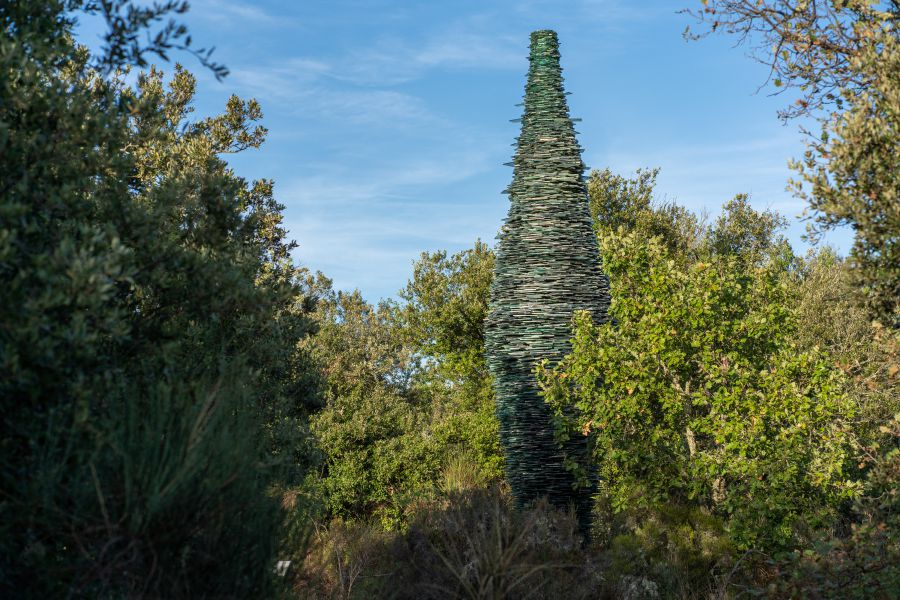
Energy – Costas Varotsos – Ph Fabio Giamello
Another work dating from the Park’s early years is Xaris (2002) by Adriano Visintin (Pordenone, 1947). Made from corten steel, the sculpture is distinguished by a curved, harmonious form reminiscent of a stylised ballerina bending forward to touch her toes, almost a figure suspended between geometry and nature. The title refers to the Greek word “charis”, associated with the concepts of grace and beauty, encapsulating the artist’s exploration of the relationship between formal rigour and emotion.
The relationship between architecture and landscape emerges, instead, in Coin de bois blanc (2003) by Nicolas Bertoux (Paris, 1959). The marble intervention creates a highly evocative space within the woodland: a geometric, silent presence that seems to construct a room without walls. The white stone, a symbol of the sculptural tradition, contrasts with the natural materiality of the trees, prompting a reflection on permanence and change.
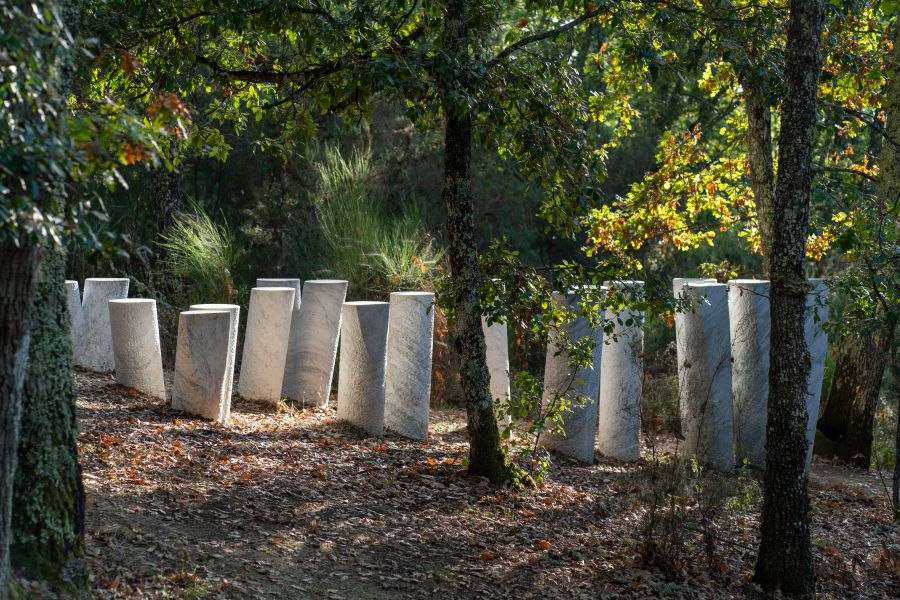
Coin de Bois Blanc by Nicolas Bertoux – Ph Fabio Giamello
Another strongly distinctive work is Rainbow Crash (2003) by Federica Marangoni (Padua, 1940). A pioneer in the use of glass and light as expressive tools, the artist introduces a powerful burst of colour into the woodland. The work almost resembles a luminous fracture in the landscape: colour becomes a physical presence capable of altering the perception of space.
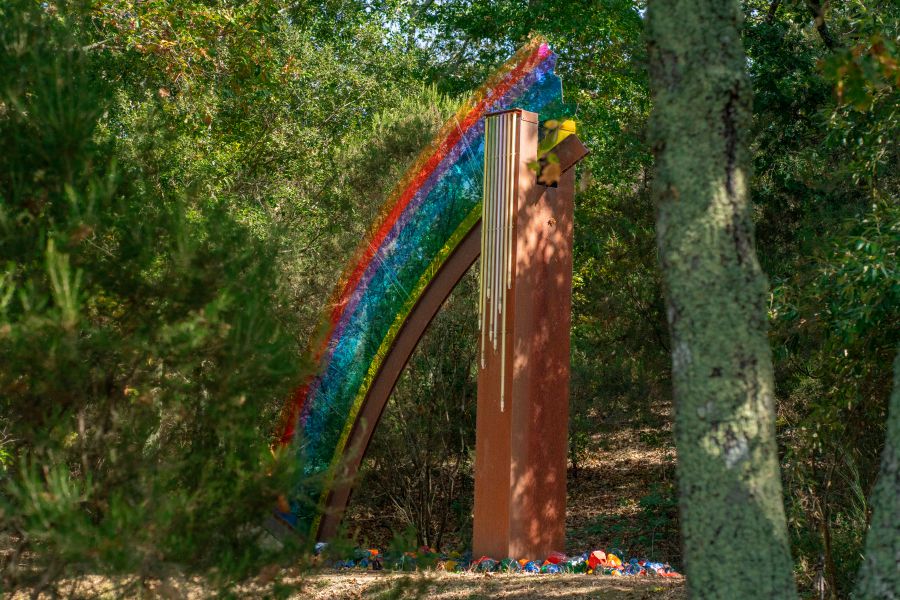
Rainbow Crash – Federica Marangoni – Ph by Fabio Giamello
Among the Park’s more narrative works is The Milk Factory (2002) by Vincent Leow (Singapore, 1961), an artist known for a language that combines irony and social criticism. The work draws inspiration from the birth of Dolly the sheep, the first mammal to be cloned from an adult cell in 1996, to reflect on the relationship between nature, technology and the manipulation of life. The “milk factory” thus becomes a metaphor for the transformations introduced by biotechnology: a surreal and provocative image which, immersed in the woodland, invites visitors to question the boundaries between the natural and the artificial.
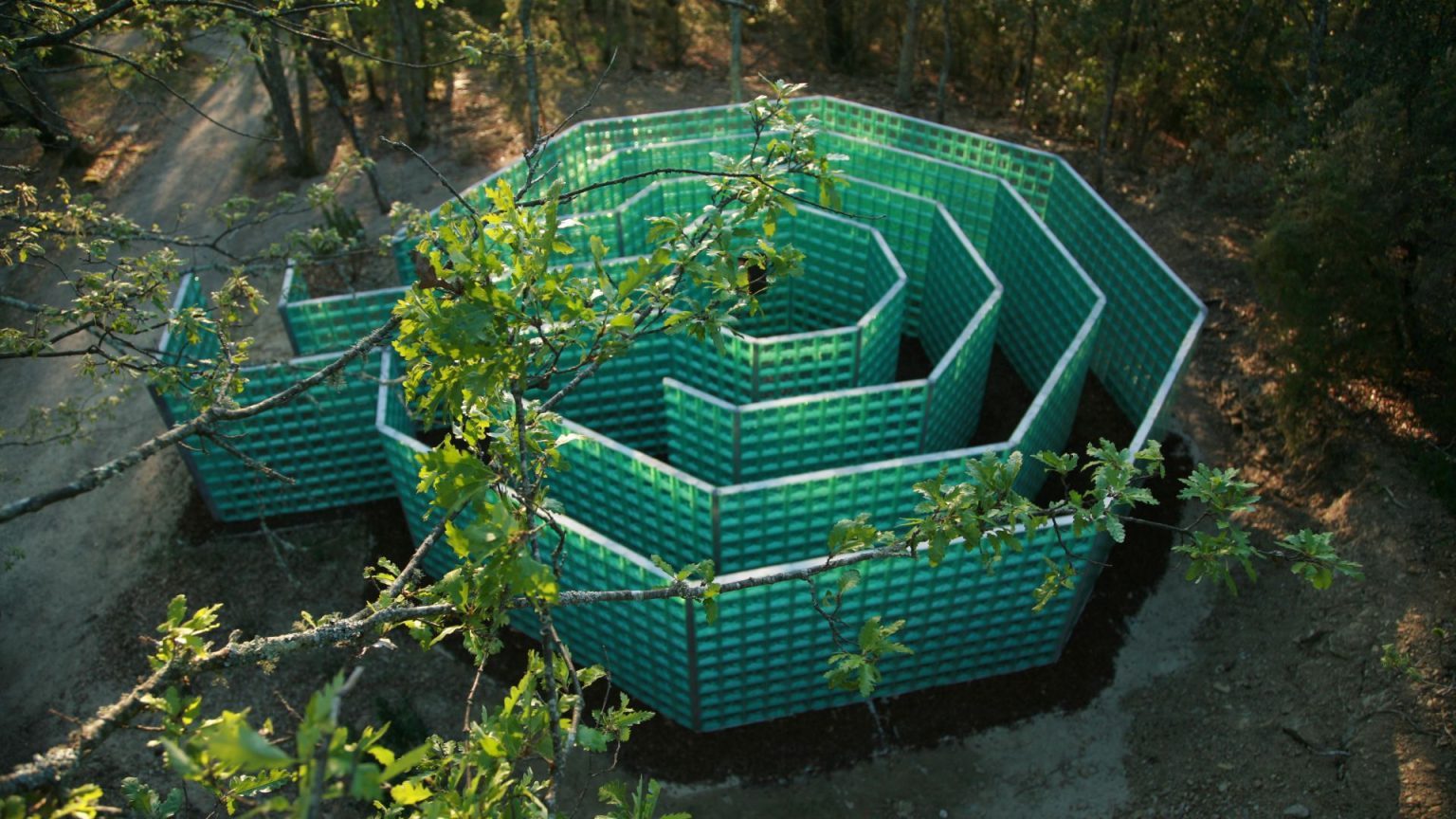
A physical and symbolic experience is offered by Labirinto (2007) by Jeff Saward (England, 1951), considered one of the world’s leading experts on labyrinths and among the most important contemporary creators of these symbolic structures. Founder of the Labyrinthos study centre, Saward has devoted his research to the history, design and construction of labyrinths around the world.
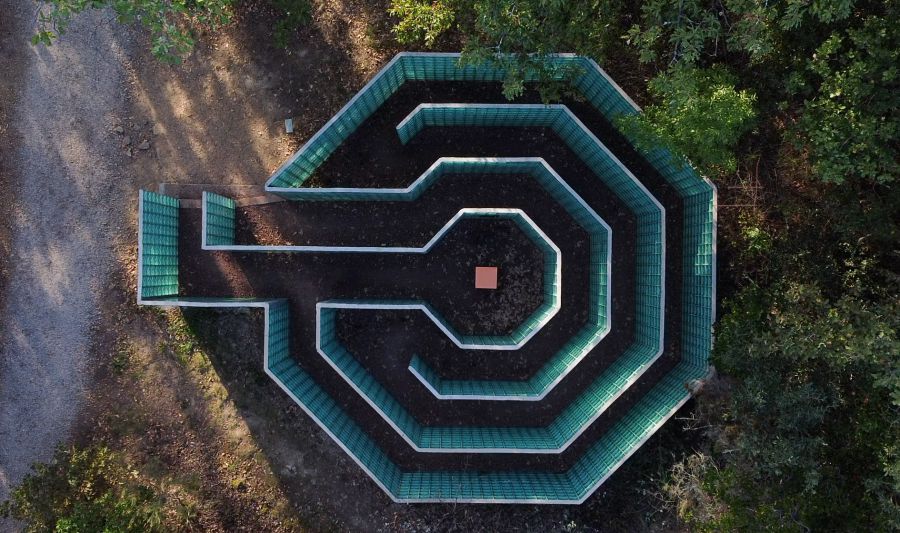
Labirinto by Jeff Saward – Ph Fabio Giamello
Made from square pieces of coloured glass produced in Florence, the Park’s labyrinth extends for approximately 75 metres along a concentric path leading visitors towards a small central space, where an orange mosaic seat and a mirror invite contemplation. The work draws on the ancient symbol of the labyrinth, found in many cultures as a metaphor for the human journey, inner exploration and the relationship between being lost and finding knowledge. Derived from a rock engraving in Val Camonica dating back to the Iron Age, Saward’s work transforms an ancient archetypal symbol into a contemporary experience: the visitor does not simply observe the artwork but walks through it, becoming part of it. “The labyrinth is not meant to make us lose our way, but to help us find ourselves,” the installation seems to suggest, turning physical movement into a metaphor for a personal journey.
The Park is also a place of symbolic crossings. The Blue Bridge (2001) by Ursula Reuter Christiansen (Germany, 1943) is one of the trail’s most poetic works and the only one created for the the 2001 Venice Biennale. An important figure in the European post-war art scene, the German artist created a bridge made of iron and glass, composed of blue tiles, crossing the space like a suspended threshold. The bridge becomes a metaphor for connection: a link between places, cultures and people. “To unite two spaces is to create a dialogue,” the work seems to suggest, inviting visitors to reflect on the symbolic value of crossing from one place to another. Connected instead to memory and the territory is La pietra sospesa (2001) by Mauro Berrettini (Buonconvento, Siena, 1943). The Sienese sculptor created a travertine work that plays with the contrast between weight and lightness. A large stone appears suspended within a minimalist architectural structure, creating a poetic tension between the strength of matter and the perception of movement. The work seems to pose a question: how light can something that appears heavy be? And how solid can an apparently fragile impression become?
From Korea comes Island (2000) by Kim Hae Won (South Korea, 1964), a work that reflects on the relationship between the individual and the environment. The sculpture evokes the idea of an island as both a physical and mental place: a space of separation, introspection and inner exploration. Set within the woodland, it takes on the character of a place for pause, almost a point of meditation along the trail. The exploration of pure form also finds its place in the Park through Homage to Brancusi (2001) by Benbow Bullock (United States, 1948), a work paying tribute to the research of the great Romanian sculptor Constantin Brâncuși. The simplification of form and the essential quality of the material – burnished steel – bring to the fore one of the fundamental questions of modern sculpture: the ability of a minimal form to evoke universal meanings.
Among the more recent works is Il porcino di Mario (2021) by Emanuele Rela (Barga, 1977). Created from a centuries-old pine trunk felled by a storm, the large mushroom sculpture perfectly embodies the Park’s philosophy: transforming a natural element without erasing its history. Rela, whose artistic research is rooted in the relationship between wood, the environment and craftsmanship, gives new life to a material that had reached the end of its natural cycle. “Wood preserves a memory” is the principle guiding his work: every grain and every imperfection becomes part of the artwork. Another work exploring the connection between matter, memory and territory is that of Roberto Cipollone (Pescara, 1947), an artist known for his practice of recovering simple materials and forgotten objects. Through assemblages and poetic compositions, Cipollone gives new life to everyday elements, transforming them into images capable of evoking memories, stories and impressions. His presence in the Park reinforces one of the collection’s central themes: the possibility of transforming what appears marginal or destined for abandonment into a new form of beauty. Humble materials thus become memory, narrative and testimony to the relationship between humanity and the environment.
A more contemplative dimension can be found in Il Pensatore (2013) by Ichwan Noor (Indonesia, 1963). The figure invites reflection and seems to establish a silent dialogue with the visitor. Immersed in the woodland, the work amplifies the theme of inner exploration: thought becomes a slow gesture, in harmony with the natural rhythm of the place.
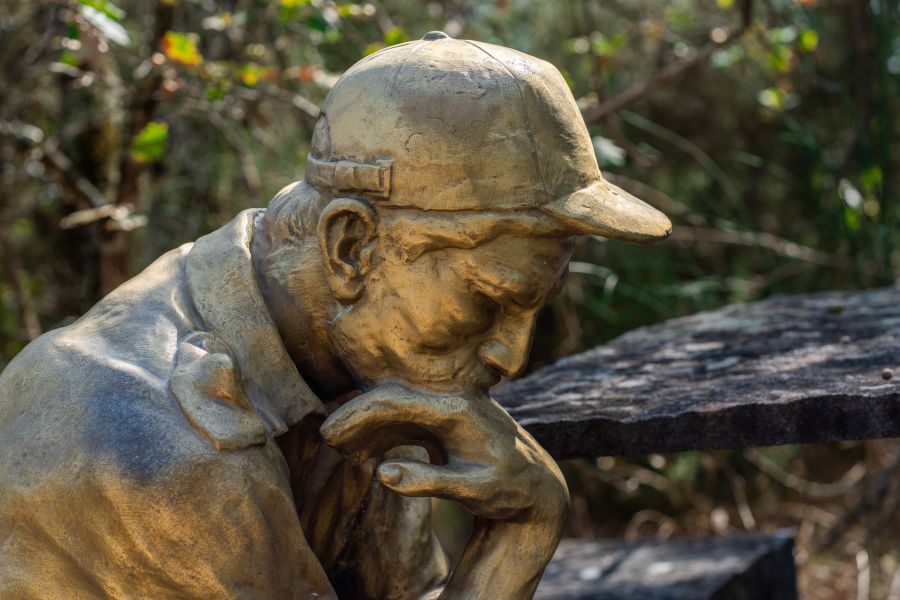
Il Pensatore by Ichwan Noor – Ph Fabio Giamello
A Museum That Continues to Grow. On 9 July, Passo dopo passo (2026) by Marco Acquafredda (Siena, 1977) was unveiled, the latest site-specific intervention to enrich the permanent collection and a perfect synthesis of the Park’s spirit. Deeply connected to the culture and landscape of Siena, Acquafredda collected hundreds of oak galls in the woodland – small natural formations produced by trees in response to the presence of external organisms – transforming them through gilding and placing them back onto the trunks along the paths. The result is a constellation of small luminous signs that gradually emerge into view. Not a predetermined route, but an invitation to discover.
“The inspiration comes from the fairy tale of Hop-o’-My-Thumb” the artist explains, “but here the traces are not meant to help us find our way: they are meant to make us question the journey.” The work invites visitors to slow down and observe what would normally go unnoticed. Particularly significant is the height at which the galls have been placed: it corresponds to the artist’s own body height. A minimal human presence, almost an invisible signature, confronting the immense scale of nature. Time, too, becomes an integral part of the work. The galls are organic elements destined to transform and follow the rhythm of the seasons. “The work is not complete when it is installed,” Acquafredda explains. “It continues to live through what happens around it.” As the director points out, “with Passo dopo passo, the Park welcomes a work that invites us to look at the woodland with new eyes.”
Alongside the permanent collection, the Park has also expanded over time with new spaces and projects. These include the open-air amphitheatre, built in 2009, which hosts concerts and performances in a highly evocative setting, and the Open-Air Gallery, inaugurated in 2024 to mark the Park’s twentieth anniversary, providing a new space dedicated to temporary exhibitions.
The Value of a Unique Experience. Today, the Chianti Sculpture Park represents a particularly contemporary model of the relationship between art and the environment. At a time when museums and cultural institutions are rethinking their relationship with audiences, territories and sustainability, this project demonstrates how a collection can also become an experience. Here, the value of an artwork lies not only in its material, technique or artist’s signature, but in its ability to create a relationship with the place and with those who move through it. Art leaves a trace – not necessarily a permanent one, but an impression capable of changing the way we see. And perhaps this is the true strength of the Chianti Sculpture Park: reminding us that a landscape can become a museum, that time can become artistic material and that, sometimes, encountering contemporary art does not require entering an exhibition hall.
All it takes is walking silently among the trees.
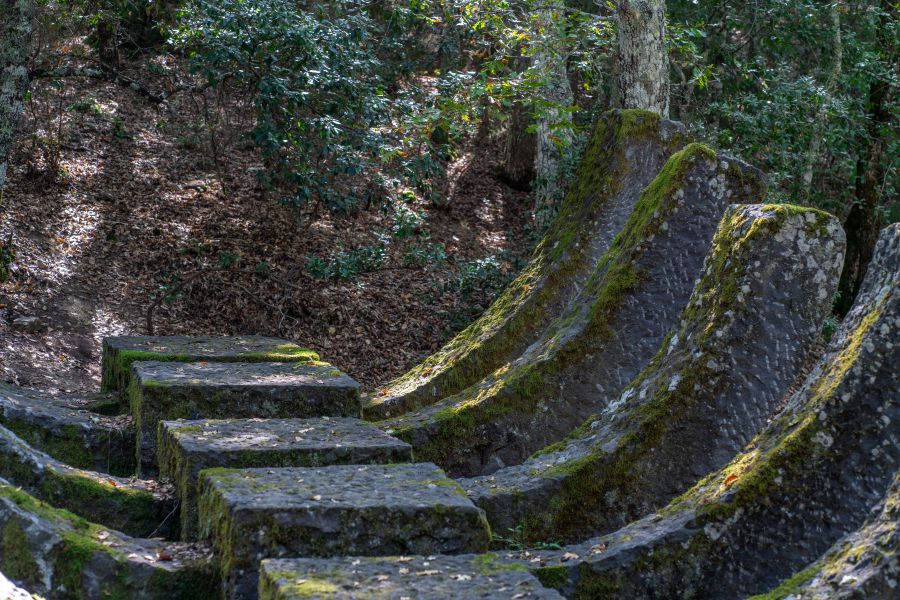
The Keel 2 by Kemal Tufan – Ph Fabio Giamello