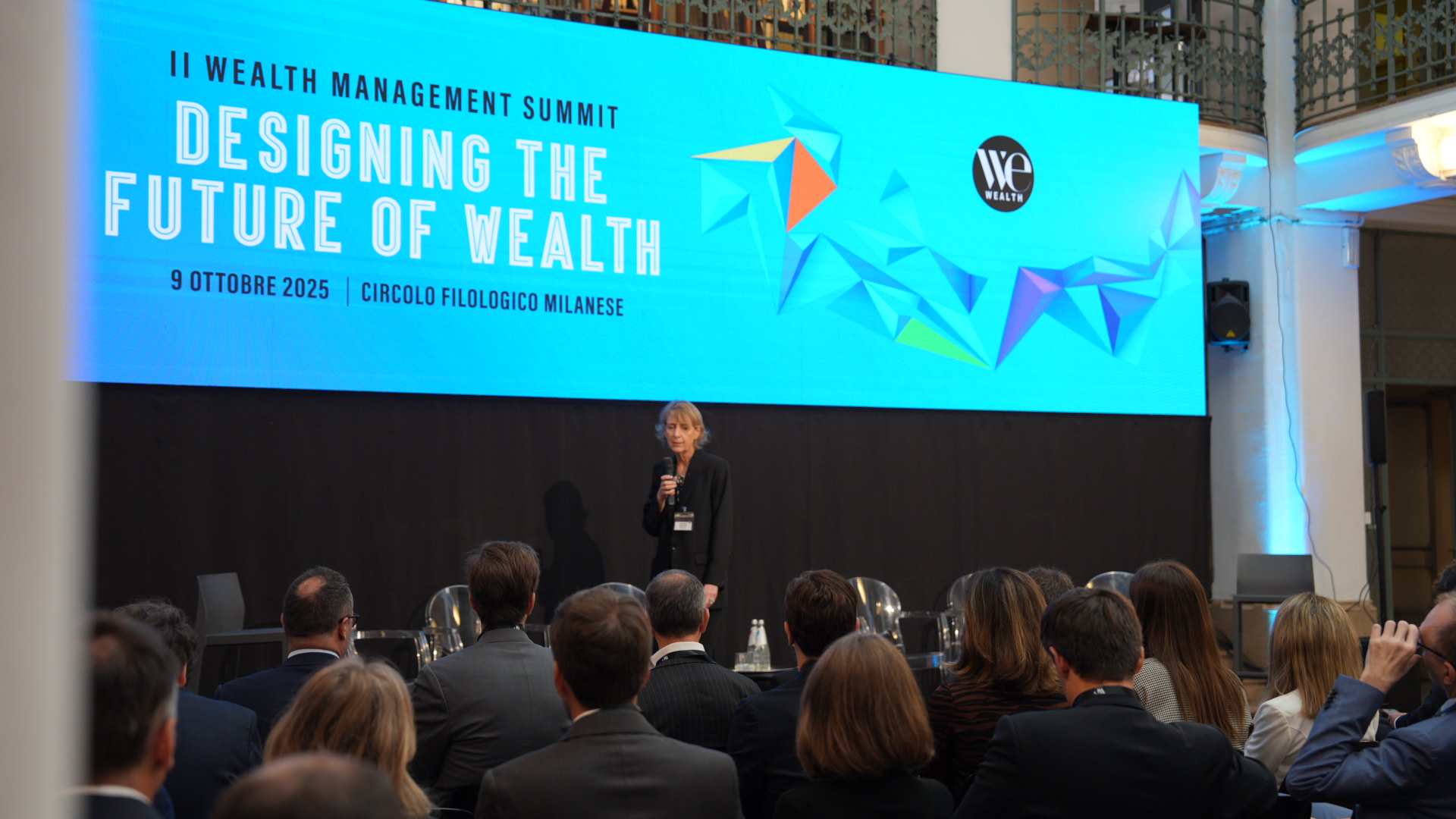
From patient capital in private markets to the longevity economy, from digital consulting to new service models, the We Wealth Summit brought together over 50 speakers and hundreds of professionals at Milan’s Circolo Filologico to chart the course for tomorrow’s wealth management.
Milan hosted the second edition of We Wealth’s Wealth Management Summit, which brought together the Italian wealth management community at the Circolo Filologico for a day of discussion, ideas and visions on the future of wealth management.
With bankers, managers, consultants, academics and representatives from the tax and legal world in attendance, the Summit offered a collective account of how wealth is changing in form, time and language in front of more than 400 top bankers and wealth advisors.
The opening address was given by Davide Serra, founder and CEO of Algebris Investments, who drew attention to a crucial point: the need to distinguish between real value and perceived value in a world where global debt is growing faster than wealth itself.
Serra called for a ‘return to fundamentals’, focusing on quality assets, diversification and a more informed understanding of monetary dynamics and central bank policies.
The macroeconomic and structural dimension was also the focus of the presentation by McKinsey & Company, knowledge partner of the Summit.
Jonathan Godsall, Senior Partner, Co-Leader of McKinsey & Company‘s Global Wealth & Asset Management practice, and John Euart, Partner Wealth & Asset Management and Private Equity Practices, took turns on stage, followed by speeches by Stefano Cantù and Cristina Catania, respectively partner and senior partner at McKinsey & Company, who outlined four complementary perspectives: the evolution of wealth management business models, the technological transformation of advisory networks, the impact of longevity on planning strategies, and the new role of female segments in wealth management.
A clear message emerged: wealth management can no longer be limited to managing portfolios, but must accompany increasingly long, complex and interconnected lives with flexible tools and a new language.
Next, the MIT AgeLab in Boston – represented by its director Joseph Coughlin – brought an international perspective on the longevity economy. Living longer, he pointed out, does not just mean having more years to invest, but redefining entire phases of economic, educational and family life.
This is a theme that is intertwined with wealth management, which today is called upon to respond to needs that go beyond the logic of return to embrace that of protection, care and continuity.
The regulatory and strategic horizon was explored in depth by Andrea Ragaini, president of AIPB, the Italian Private Banking Association, who highlighted the increasingly central role of private banking in connecting savings and business, finance and development. In a country of entrepreneurs, Ragaini noted, private banking can become a bridge between productive capital and financial capital, supporting the real economy and generational transition.
The Summit then covered the main thematic areas that are currently reshaping the industry: private markets as a lever for attracting patient capital and generating sustainable growth; real estate and infrastructure as pillars of stable returns; hybrid advisory services combining digital platforms and human value; and the evolution of insurance offerings, with life insurance policies returning to their role as key tools for intergenerational planning and protection for global families.
The common thread running through the day was the need to integrate technology, empathy and long-term vision. As also emerged in the double dialogue dedicated to artificial intelligence, AI does not replace consulting but amplifies it, restoring time and quality to the relationship with the customer.
The day ended with words from We Wealth CEO Fabienne Mailfait, who thanked partners and guests for helping to build a new platform for dialogue between capital, people and innovation:
‘Behind every number and every transformation,’ he recalled, ‘there are people who build trust every day over time.’
The date has already been set for the Wealth Management Summit 2026, with a clear objective: to continue to recount the evolution of value, within and beyond wealth.
In the coming days, video clips of the Summit’s round tables and one-to-one interviews will be published on we-wealth.com and on social media channels. Follow all the updates at this link: https://landing.we-wealth.com/wealth-management-summit-2025